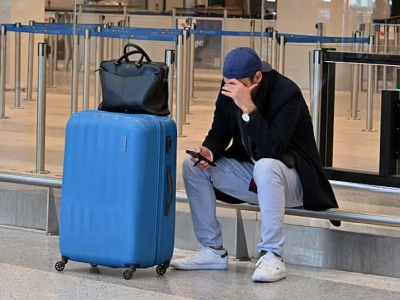

The Foreign, Commonwealth and Development Office (FCDO) provides regularly updated travel advice for British nationals

An FCDO warning can affect your travel insurance(Image: Getty)
The Foreign, Commonwealth and Development Office (FCDO) offers regularly updated travel guidance for British nationals travelling abroad. It’s crucial to review the latest FCDO advice prior to your departure, as it may impact your holiday arrangements and travel insurance coverage.
Opting to travel contrary to FCDO warnings can render your travel insurance invalid. Additionally, you may discover that consular support is extremely restricted should you encounter an emergency. On its travel advice page, the government agency states: “No travel can be guaranteed safe. Read all the advice in this guide.”
To protect British nationals journeying overseas for business or leisure, the FCDO supplies current travel advice for every country globally. It’s vital to examine this guidance before each trip.
Should the FCDO deem a situation hazardous, it may recommend against all travel or solely non-essential travel to a certain country or particular areas within it. Alongside travel advisories, the FCDO delivers valuable information, including entry requirements, crime figures, local legislation and traditions, and information regarding any upcoming strikes or industrial action that might affect your holiday.
It’s worth noting that if the FCDO issues an advisory against all travel or all but essential travel to your selected destination prior to your departure, your travel insurance is unlikely to offer coverage. As a result, any claims you submit will most likely be declined. Travel insurance is intended to protect you against unexpected and unforeseen circumstances. However, travelling to a destination that the FCDO has deemed dangerous carries a substantially higher risk than visiting a country generally considered safe, reports the Mirror.
Should the FCDO issue a warning while you are already in an affected area, you will remain covered under the medical and personal accident sections of your travel insurance policy. However, this is conditional upon you following the latest FCDO guidance for British nationals in that location.
While most travel insurance policies do not provide cover for trips taken against official advice, there are a small number of exceptions. These specific policies were initially designed to protect people travelling to high-risk areas for work purposes, such as journalists and aid workers. However, they are increasingly being purchased by leisure travellers determined to proceed with their plans during the COVID-19 pandemic.
Political instability, natural disasters, and safety concerns are amongst the factors that can trigger an FCDO warning. The FCDO has issued numerous travel advisories, recommending against “all travel” and “all but essential travel” to certain countries or regions across Europe, Africa, Asia, and South America. Of the 226 countries featured on the FCDO’s travel advice page, certain destinations are currently designated as ‘do not travel’ zones due to a range of concerns that ‘cannot guarantee safety’, including security threats, health risks, and legal differences from Britain. Your travel insurance may be rendered void should you travel in contradiction of FCDO guidance regarding the following nations, as of April 2026.
Afghanistan
The FCDO advises against all travel to Afghanistan, stating: “Your travel insurance could be invalidated if you travel against advice from the FCDO.” The government body warns that the security situation remains volatile, and tensions between Afghanistan and Pakistan have previously led to violent clashes in border areas.
It further states: “Travel throughout Afghanistan is extremely dangerous and a number of border crossings are not currently open. There is a heightened risk of British nationals being detained in Afghanistan. If you are a British national and you are detained in Afghanistan, you could face months or years of imprisonment. FCDO’s ability to help you is extremely limited and support in person is not possible in Afghanistan. For more details about the risks in Afghanistan, see Safety and security.”
Belarus
The FCDO advises against all travel to Belarus. Those who have previously engaged in any activity now deemed illegal by the Belarusian regime face a considerable risk of arrest. There is additionally a low risk that direct conflict stemming from the war in Ukraine could spill over into Belarus. Find out more about why FCDO advises against all travel.
Burkina Faso
The FCDO advises against all travel to Burkina Faso, citing the threat of terrorist attacks and kidnappings, as well as the country’s volatile political climate.
The guidance states: “There is no British Embassy in Burkina Faso and all consular support is provided from the British Embassy in Accra, Ghana. They cannot provide in-person assistance. If there is serious violence, unrest or a deterioration in the security situation, it could be difficult to leave safely.
“Do not rely on the British government to evacuate you, as they may not be able to do so. Have your own plans on how you would leave the country, make sure you keep all travel documentation up to date and monitor the local situation.”
Haiti
The FCDO advises against all travel to Haiti due to the country’s unstable security situation. There are currently no British consular officials based in Haiti, meaning in-person consular assistance is severely limited.
British nationals requiring consular support are directed to the diplomatic mission in the Dominican Republic. The government agency states: “If you choose to travel to or stay in Haiti against FCDO advice, try to avoid all crowds and public events, and take appropriate security precautions.”
Iran
FCDO advises against all travel to Iran. It states: “If you are a British national already in Iran, either resident or visitor, carefully consider your presence there and the risks you take by staying. British and British-Iranian dual nationals are at significant risk of arrest, questioning or detention.
“Having a British passport or connections to the UK can be reason enough for the Iranian authorities to detain you.” British nationals should:
- read if you’re affected by a crisis abroad. This includes guidance on ‘how to prepare for a crisis’ with suggestions on what you might include in your emergency supplies and ‘what to do in a crisis’
- sign up to FCDO Travel Advice email alerts
- monitor local and international media for the latest information
- stay away from areas around security or military facilities
- keep your departure plans under review, and ensure your travel documents are up to date
- if you are advised to take shelter, stay indoors or find the nearest safe building or designated shelter. An interior stairwell or a room with as few external walls or windows as possible may provide additional protection
Mali
The FCDO is urging all travellers to avoid Mali entirely, citing deeply unpredictable security conditions. Those already in the country are being strongly advised to depart immediately via commercial flights, where it is deemed safe to do so.
The FCDO states: “The international airport in Bamako is open, and commercial flights are available. Do not try to leave Mali by overland routes to neighbouring countries, as this is too dangerous. This is due to terrorist attacks along national highways. Terrorist group Jama’a Nusrat ul-Islam wa al-Muslimin (JNIM) has implemented blockades on key routes throughout Southern and Western Mali, including the capital city of Bamako.
“These blockades are targeting fuel trucks and are enforcing checkpoints for individuals attempting to pass through them. Attacks can occur at any time. There is a high threat of kidnapping and criminal activity across Mali, including in the capital, Bamako. If you choose to remain in Mali, you do so at your own risk. You should have a personal emergency plan that does not rely on the UK government. If you are a British national already in Mali, either resident or visitor, carefully consider your presence there and the risks you take by staying.”
Niger
The FCDO has also issued advice against all travel to Niger, following a surge in reported terrorist activity and criminal kidnappings targeting foreign nationals throughout the country this year. There is a persistent threat of terrorist attacks across Niger, including in the capital city of Niamey. The political landscape remains volatile in the wake of the military coup in July 2023, with the prospect of further unrest remaining very real.
Russia
The FCDO advises against all travel to Russia owing to the dangers and threats posed by its ongoing invasion of Ukraine, including:
- security incidents, such as drone attacks, and Russian air defence activity
- lack of flights to return to the UK
- limited ability for the UK government to provide support
The risk of British nationals being detained in Russia has significantly increased, particularly if Russian authorities suspect involvement in or support of activities that contravene Russian law, even if those activities occurred outside of Russia.
Russia has a well-documented history of targeting foreign nationals and holding them in custody as a bargaining tool against other nations. The FCDO’s capacity to provide assistance in such circumstances is severely limited. There is also a considerable likelihood that terrorists will attempt to carry out attacks, including in major cities.
South Sudan
The FCDO strongly advises against all travel to South Sudan due to the threat of armed conflict and criminal activity. The political and security situation remains highly unpredictable. Political tensions are running high, and the security landscape across the country could deteriorate swiftly and without warning.
Should the volatile security situation worsen, routes in and out of South Sudan could be cut off. Juba airport may shut down or become unreachable, with flights potentially cancelled at little notice. Developments across the region may also disrupt international transport links. For instance, in both 2019 and 2023, unrest in Sudan caused South Sudan’s airspace to close temporarily. Consular support for British nationals remains severely restricted in South Sudan, with no in-person assistance available.
Syria
The FCDO advises against all travel to Syria owing to unpredictable security conditions and the ongoing threat of terrorist attacks. Regional escalation poses significant security risks and has led to significant travel disruption. British nationals should:
- read If you’re affected by a crisis abroad. This includes guidance on “how to prepare for a crisis” with suggestions on what you might include in your emergency supplies and “what to do in a crisis”
- follow advice from the local authorities and sign up to receive information and alerts
- sign up to FCDO Travel Advice email alerts
- monitor local and international media for the latest information
- stay away from areas around security or military facilities
- keep your departure plans under review, and ensure your travel documents are up to date
- if you are advised to take shelter, stay indoors or find the nearest safe building or designated shelter. An interior stairwell or a room with as few external walls or windows as possible may provide additional protection
Yemen
The FCDO advises against all travel to Yemen, citing unpredictable security conditions. Those currently in Yemen are urged to leave immediately.
The guidance states: “Support for British people is severely limited in Yemen. British Embassy services in Sana’a are suspended, and all diplomatic and consular staff have been withdrawn. The UK government cannot help British nationals leaving Yemen. There are no evacuation procedures in place.
“FCDO cannot offer advice on the safety of travelling to any potential departure point. The UK government’s ability to help with onward travel is severely limited and you’ll be expected to cover the cost of visas, accommodation, insurance and onward travel yourself. If you choose to remain in Yemen, you should minimise movement around the country and within cities and towns, monitor developments in the local security situation and follow other precautions in this travel advice.”
British nationals currently in Yemen who require assistance from the UK government are advised to contact the FCDO on 020 7008 5000, which operates 24 hours a day.