
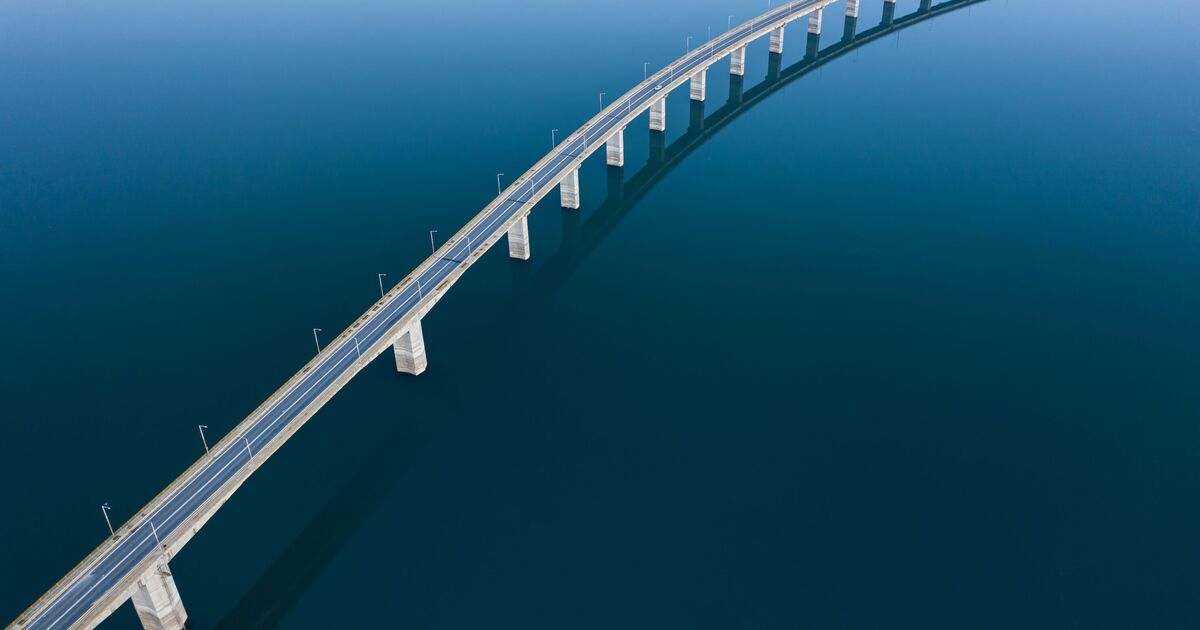
The possibility of a bridge between the UK and the island of Ireland has been discussed since the 1800s – but would it even be possible? The Irish Sea Bridge is a hypothetical infrastructure project that would stretch across the Irish Sea and link Northern Ireland to Great Britain.
It would make driving across the whole of the UK possible for the first time, greatly enhancing trade networks and tourism. Such a structure would have to be truly vast to cover the North Channel of the Irish Sea, though distances would depend upon which of various routes posited over the years was chosen.
The aftermath of the UK’s exit from the European Union, and the trade chaos between the Great Britain and Northern Ireland that followed, renewed talk of what’s known as the Galloway route.
This would connect Portpatrick in south Scotlandand Larne in Northern Ireland, a distance of 27 miles.
The long-established idea was revived in early 2018 by architect Professor Alan Dunlop who said it was “feasible” and a potential solution to the Irish Sea Border crisis, which has since been solved by the Windsor Framework in early 2023.
The second of the two routes he raised as a possibility is the 12-mile Kintyre idea, which would span from the highland peninsula of Kintyre to the northeastern point of County Antrim.
Prof. Dunlop, a Fellow of the Royal Incorporation of Architects in Scotland (RIAS), suggested a “Celtic bridge” would cost around £15billion.
During his time in Number 10, former Prime Minister Boris Johnson was interested in the idea of a fixed transport link between GB and NI and commisioned a feasibility report led by Network Rail chairman Sir Peter Hendy.
The study, published in November 2021, forecasted a price tag way above Prof. Dunlop’s estimate. It suggested a bridge would cost in the region of £335billion, and a tunnel under the Irish Sea would cost £209bn.
Sir Peter’s study found that though the technology existed at the time to build either, any bridge would be “the longest span bridge built to date,” and the tunnel would be “the longest undersea tunnel ever built”.
He noted that future transport technological advances, “particularly autonomous vehicles, could allow for different tunnel and bridge designs, which could enable the construction of a fixed transport link and approaches at a lower cost.”
However, he recommended that at that time the huge costs were “impossible to justify”.