It’s one of the world’s most famous tourism sites but the current conflict in the Middle East means it now lies empty

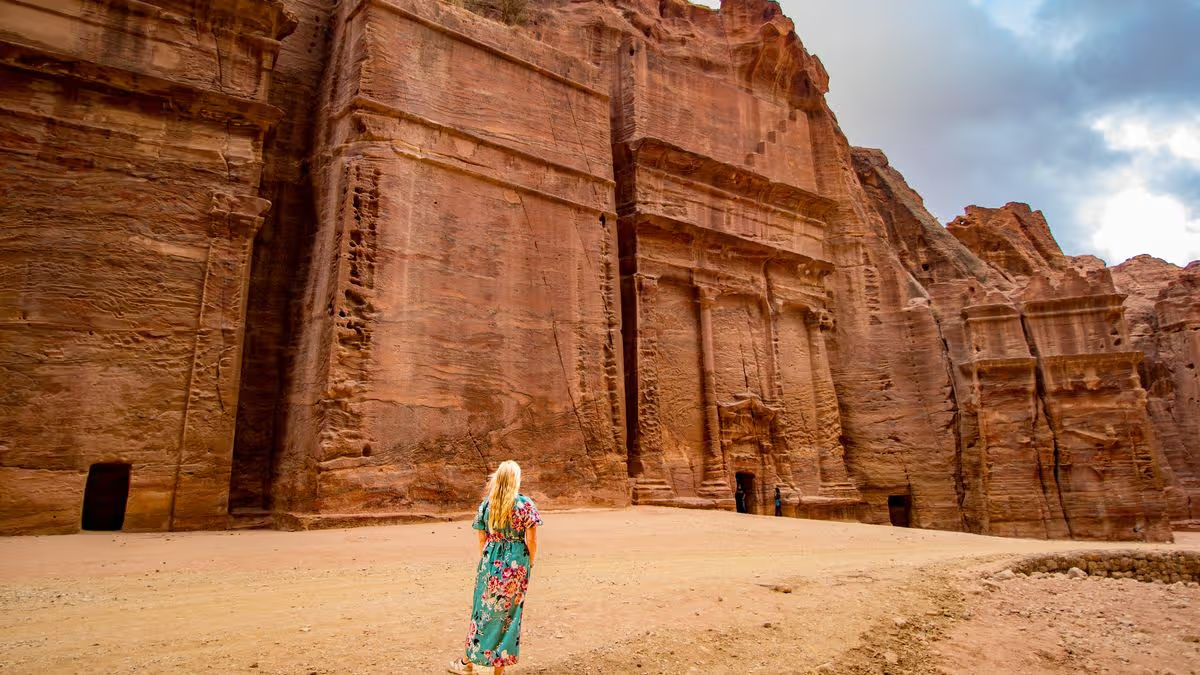
Where is everyone? (Image: Portia Jones )
One of the world’s best-known tourist attractions, which usually sees thousands of sightseers in attendance every day, is currently empty amid the ongoing conflict in the Middle East.
Twelve days ago President Donald Trump announced the US military was working with Israel to try to remove Iran’s current regime.
As the war has escalated many British holidaymakers have found themselves stranded across the Middle East with dozens of flights cancelled.
The UK Foreign, Commonwealth, and Development Office (FCDO) has also advised against travel to many destinations in the Middle East including Jordan, which is home to the Unesco world heritage site of Petra that is now left without visitors.
In 2022 Petra, a remarkable historical and archaeological city in Jordan, welcomed 905,000 visitors, finally recovering from the pandemic-driven drop in tourism.
At its peak the Unesco site, also known as one of the New Seven Wonders of the World, welcomed 1.1m visitors in 2019.
On October 7, 2023, Hamas and other Palestinian militant groups launched a surprise attack on Israel, starting a war that gripped the Middle East for more than a year. The ceasefire was signed just last month.
Jordan borders Israel and the war has had a devastating impact on tourism in Jordan – especially in places like Petra where locals rely on tourism income.
The latest conflict in the Middle East has caused another drop in visitor numbers as airspace closes and airlines cancel flights to destinations such as Dubai, Abu Dhabi, and Jordan.
I visited Jordan before the US-Israel conflict with Iran and was amazed by how quiet the site was, especially around the usually crowded Treasury, Petra’s most elaborate rock-cut tomb and its crown jewel.
Petra is a legacy of the Nabataeans, an industrious Arab people who settled in southern Jordan more than 2,000 years ago.
My local tour guide, Zuhair, said it was “the biggest tourist attraction that we have here in Jordan,” drawing visitors from all over the world.
But as I looked around the Treasury (Al-Khazneh) I was shocked to see no-one else there.
“At this time of year it should be the peak,” said Zuhair. “Two years ago there were days when we had over 10,000 visitors.”
Zuhair said since the conflict between Hamas and Israel began in October 2023 tourism in the area had dropped sharply. The latest fighting only reinforces the perception that Jordan is unsafe and the FCDO’s ‘do not travel’ warning is another huge setback.
Because Jordan shares a border with Israel the current conflict has hit its tourism industry hard. Many would-be visitors see the region on the news and assume it all blurs into one unsafe zone.
In reality Jordan has stayed out of military action but because of the US-Israel conflict with Iran, airspace is now closed, and the FCDO advises against all but essential travel to parts of Jordan, including major sites like Petra and the Wadi Rum desert. Stay in the know by making sure you’re receiving our daily newsletter.
Tourism in the Middle East, worth about $367bn a year, is now on hold as the conflict continues with no definitive end in sight.
Flights at major hubs including Dubai, the world’s busiest international airport, have mostly been grounded since February 28 with limited repatriation flights.
“There’s a big collapse in bookings to the Middle East,” Michael O’Leary, CEO of budget carrier Ryanair, told reporters, adding the fallout had driven a surge in demand for short-haul flights to European destinations Portugal, Italy, and Greece ahead of the busy Easter holiday period.
Just a short time ago Jordan was struggling with too many tourists at its most famous sites. Now it faces the opposite problem as its tourism numbers have dropped to devastating lows.
When I visited the change was clear. I’d seen photos of Petra packed with tourists taking selfies all trying to get the best shot of this archaeological wonder. It felt surreal to have the famous ‘Rose City’ almost to myself.
Petra is believed to be more than 2,300 years old though the exact date of its construction is unknown. By the first century BC it was the capital of the Nabataean Empire, which grew rich from trading frankincense, myrrh, and spices.
Today Petra is an archaeological park covering 264,000 square metres in Wadi Musa. It has a visitor centre and several Bedouin shops selling coffee, snacks, and souvenirs.
An entrance ticket costs 50 JOD (about £51). The visit starts in the Siq, a narrow gorge cutting through rose-red rock. The walls rise high above, sometimes just a few metres apart, streaked with pink, russet, and gold where wind and floods have smoothed the stone.
It feels cool and echoey in places. If you visit with a guide they’ll probably show you ancient water channels carved into the rock, proving the Nabataeans were skilled engineers as well as architects.
Then the Siq opens up just enough to frame Al Khazneh, the Treasury. Carved into the sandstone cliff in the first century AD its façade rises about 40m high with Corinthian columns, ornate capitals, and dramatic details.
Our guide said Petra was the capital of the Nabataean Kingdom from around the 4th century BC. These were Arab traders who amassed fortunes by controlling caravan routes for incense, spices, and other luxuries moving between Arabia, Egypt, and the Mediterranean.
They turned this desert stronghold into a thriving city complete with temples, tombs, and a theatre that could seat thousands carved into the hillside.
Fast forward and Rome eventually annexed the city and it continued to prosper until a major earthquake in AD 363 devastated much of it.
The damage, along with changing trade routes, sped up Petra’s decline. Eventually it was abandoned and known only to local Bedouin communities.
Petra returned to Western attention on August 22, 1812, thanks to Swiss explorer Johann Ludwig Burckhardt.
Travelling under the name Ibrahim Ibn Abdallah and passing himself off as an Arab scholar he persuaded his Bedouin guides to lead him to a fabled hidden city in Jordan’s Wadi Musa.
What he found was a 12th-century marvel that reportedly was largely unknown beyond the local region.
Since then Petra has become world-famous, especially after it appeared in the 1989 film Indiana Jones and the Last Crusade, which greatly increased tourism to the site.
Wander around and you’ll see a theatre that may date to the early first century AD, the Petra Church Complex, the Pharaoh’s Column, and Qasr Bint Far’un (Palace of the Pharaoh’s Daughter).
As you walk past the Treasury you’ll start to spot a few cafes and shops run by Bedouins where you can try Arabic eyeliner, buy souvenirs, and try pomegranate juice.
Even though the government relocated the Bedouins to nearby Wadi Musa they’ve kept their shops alive inside Petra and in the 2,000-year-old caves they’ve called home for centuries. The doors are open. The shelves are stocked. What’s missing are the visitors.
“Today is good because we see tourists,” said Rosa, who sells sand art bottles, jewellery, trinkets and bright woven textiles. “Normally there is no-one.”
I’d gladly return to this incredible place and see it full of visitors again even if it means giving up my rare Instagram photos of an almost-empty Treasury.
Right now there’s no sign of when the conflict will end or when the FCDO will lift its travel warning. When the country does reopen locals will be eager to welcome tourists back and I truly hope people will return. It’s a shame not to see this incredible wonder in person.