Airline and travel operator has released an update for customersas jet fuel shortages and the Middle East conflict raise concerns over summer holidays

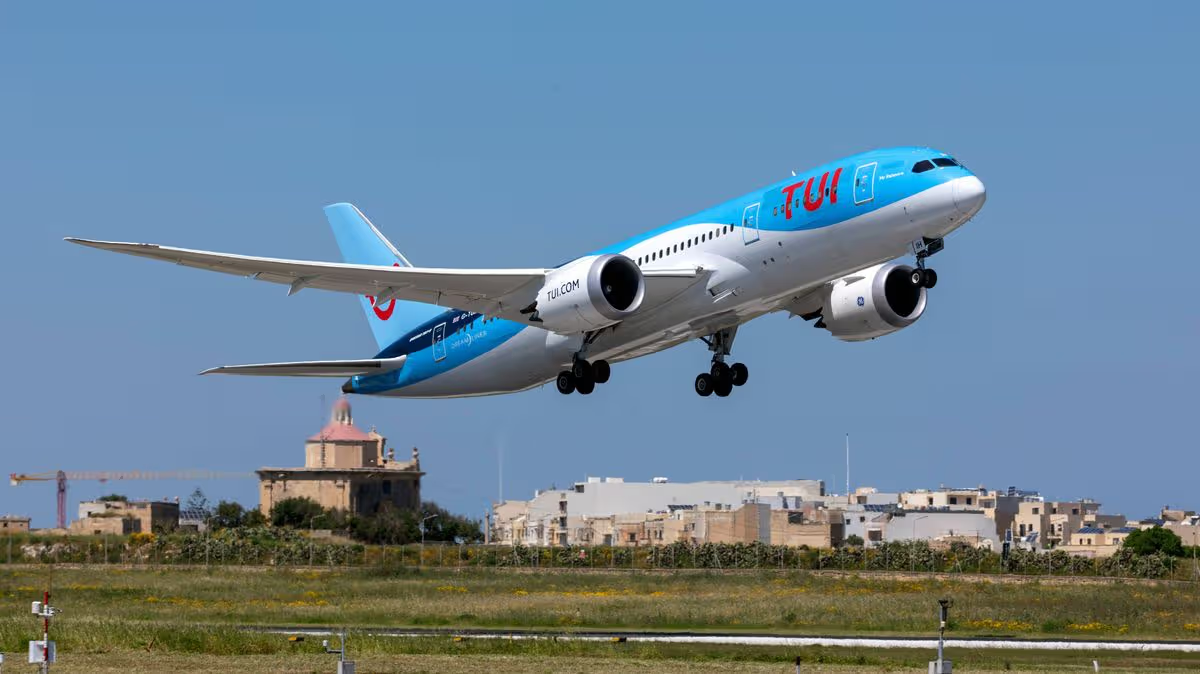
TUI has given new statements to travellers on the latest situation in the Middle East(Image: Getty Images)
Holiday giant TUI has issued updated guidance for all customers ‘due to travel’ amid growing concerns over jet fuel availability and whether flight routes could be affected by the ongoing Middle East conflict. British holidaymakers have been taking to social media in their droves, quizzing major airlines about whether their summer getaways will be disrupted.
Last week, the head of the world’s leading energy watchdog warned that Europe has just six weeks’ worth of jet fuel remaining due to the Middle East conflict. Now, in a fresh statement just released, TUI has addressed passengers directly.
In an update on its website for ‘customers due to travel’, TUI said: “We’d like to reassure customers that their safety and wellbeing remain our highest priority. We are closely monitoring the evolving situation in the Middle East, as well as the latest guidance issued by the UK Foreign, Commonwealth and Development Office (FCDO).
“There is currently no FCDO advice against travel to the destinations where we are operating. Holidays are continuing as planned, and customers in resort are enjoying their breaks as normal. We continually review all FCDO updates, and if any changes to travel advice affect upcoming holidays, we will contact impacted customers directly. TUI will never operate holidays to any destination or region where the FCDO advises against all but essential travel.
“For the latest official information, customers can refer to the FCDO Travel Advice website.” Regarding those considering travel to the Middle East, it stated: “We are currently monitoring the situation across the Middle East and the latest guidance issued by the UK Foreign, Commonwealth and Development Office (FCDO). As of 1 March, the FCDO advises against all but essential travel to the United Arab Emirates (UAE), Qatar and Bahrain.”
“FOR CUSTOMERS DUE TO TRAVEL TO THE UAE OR QATAR OR TRANSIT THROUGH: Due to airspace restrictions in parts of the region, flights to and from the UK have been impacted and will experience delays or cancellations.
“If you are due to travel to, or transit through, the UAE or Qatar on or before 1st May, our pre-travel team will contact you ahead of your departure date to discuss your options.
“We are working through bookings in departure date order. If you would prefer to speak with us sooner, please call 0203 451 2688. Please note we are currently receiving a high volume of calls and there may be a delay in answering. We appreciate your patience while our teams assist customers.”
Passengers have also been reaching out to TUI on social media to enquire whether holidays in May and June might be affected. Many are questioning, given the jet fuel situation, whether the airline expects the trips to proceed as planned. In response, TUI said that should any changes arise, they will inform passengers at the earliest opportunity. One response stated: “We’re closely monitoring the situation. We’re working with our airline partners to make sure everything runs smoothly, and at the moment, there’s no indication that your holiday will be affected. If anything changes, we’ll update you straight away.”
EasyJet revealed the Middle East conflict cost it approximately £25 million in elevated jet fuel prices last month. The Luton-based carrier said it anticipates reporting a headline pre-tax loss of between £540 million and £560 million for the six months ending in March.
Oil prices – which significantly influence the cost of jet fuel – surged in reaction to Iran’s grip on tankers navigating through the Strait of Hormuz. The conflict has created “near-term uncertainty around fuel costs and customer demand”, easyJet confirmed.
Bookings have dropped two percentage points for the three months ending in both June and September when compared with the same period last year. Fears have emerged that airlines could be forced to ground flights due to jet fuel shortages, however easyJet chief executive Kenton Jarvis insisted that all airports the carrier serves are “operating as normal”. He continued: “We only ever in this industry have three to four weeks visibility (of jet fuel supplies), and that is the same as it was pre-crisis.
“We have visibility to the middle of May, and we have no concerns. What we’re seeing is airports and fuel suppliers working well to bring jet fuel to the airports.”
However, the head of the world’s leading energy watchdog, the International Energy Agency, cautioned that Europe has “maybe six weeks or so (of) jet fuel left”. Executive director Fatih Birol told the Associated Press that flight cancellations could occur “soon” if oil supplies continue to be restricted by the Iran war.
A Government spokesperson said: “We continue to engage with British airlines to support their operations against the backdrop of war in the Middle East, and to limit the impact on passengers.
“Most airlines purchase their aviation fuel in advance to offset price fluctuations, however we are aware of the impact to businesses, and are working with international allies to see a reopening of the Strait as soon as possible.”