
As the World Travel Market (WTM) kicks off in London, the way we will be travelling in the future has been put in the spotlight. The four-day extravaganza for the travel industry—one of the world’s major tourism events—celebrates its 45th anniversary in 2025 and will see more than 5,000 exhibitors from around the world and in excess of 45,000 industry professionals attending the London symposium.
Yesterday, at a packed news conference on the opening day (4 November), the latest WTM Trends Report 2025 was unveiled. The report, conducted by Tourism Economics, an Oxford Economics company and a leading global economic forecaster and provider of quantitative analysis, reveals a promising future for the travel industry.
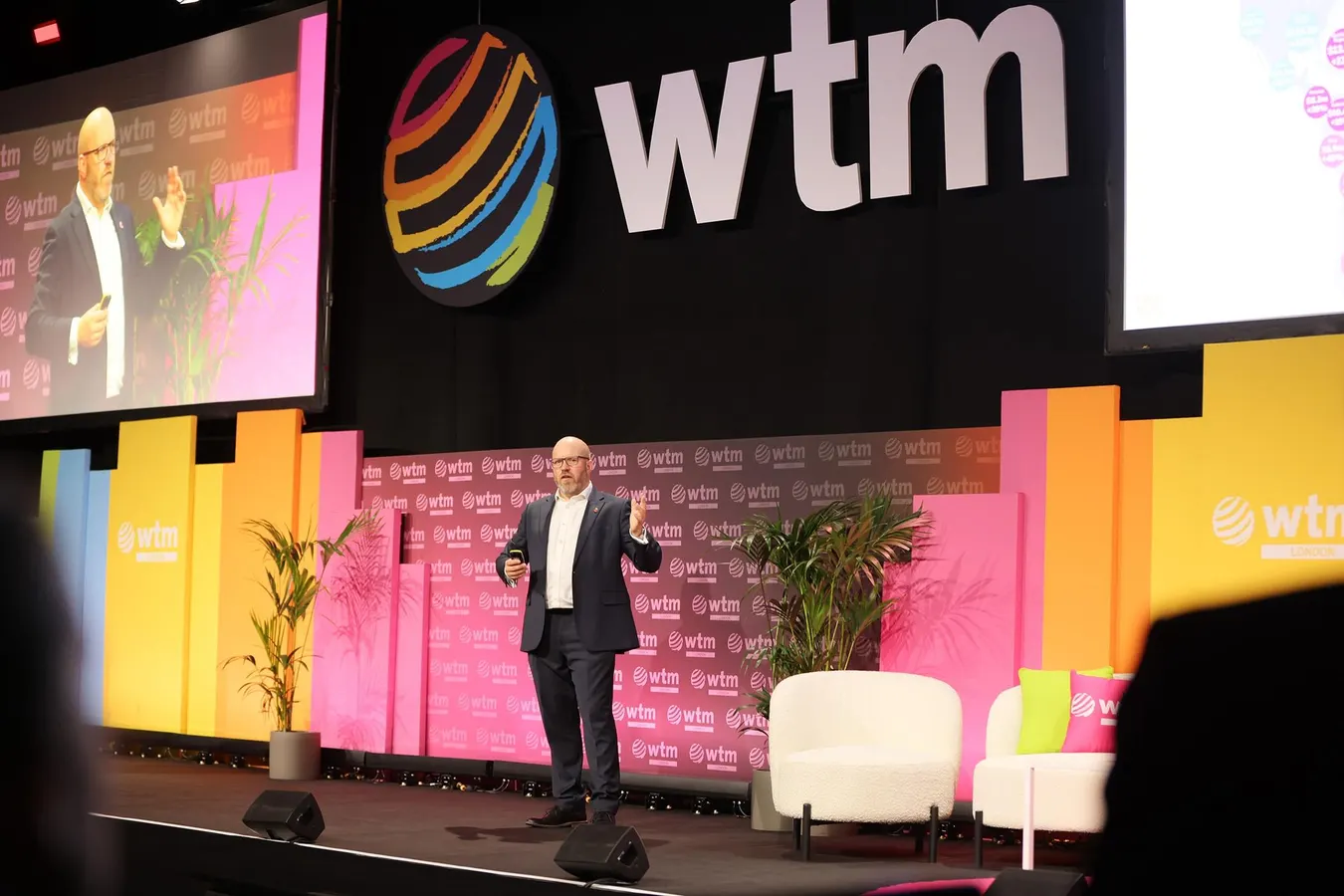
Dave Goodger, managing director, Tourism Economics EMEA, reveals the WTM Trends Report 2025.
(Credit: WTM)
Unveiling the research, Dave Goodger, managing director, Tourism Economics EMEA, revealed how tourism continues to outpace economic growth. “While there is some concern around economic conditions, travel continues to outpace economic growth and we expect this to continue over the next 10 years,” says Goodger. “We expect travel and tourism GDP to grow 3.5% on average over the next 10 years with international and leisure sectors, in particular, showing continued growth.”
In 2025, global travel has bounced back from the economic turndown following the pandemic, reaching new record levels. “International arrivals are set to increase to more than 1.5 billion this year, surpassing the previous record achieved in 2019.”
The report unveiled at WTM shows how and where we will be travelling over the next 5+ years.
(Credit: WTM)
The key trends unveiled showed that travelers are staying longer in a destination, reversing the prior trend of taking more frequent but shorter trips. “This shift is particularly notable in the Middle East where trip lengths have increased by around two-thirds compared to 2019,” says the report. The increased prominence of Saudi Arabia and significant investment in the infrastructure across the region may be among the reasons visitors are choosing to stay longer in this part of the world.
Also causing a change of behaviour among consumers are climate considerations. Factors, such as excessive heat and wildfires, have seen an emerging trend of shifting demand from the peak summer season to shoulder or off-season periods. This has also sparked the trend of ‘cool-cations’ with travel to some Nordic countries—Sweden, Norway and Finland—expected to grow by 9% in 2025, outpacing more traditional summer destinations.
The Middle East and, in particular, Saudi Arabia, show promise of increased tourism, says the report.
(Credit: WTM)
Bucket list destinations are set to remain popular, with the top 50 urban destinations poised for a 20% growth in international arrivals over the next five years, with Dubai and Bangkok leading the charge. The report also reveals that, as travelers look for new experiences and value for money, alternative destinations are becoming increasingly popular, with Albania and El Salvador showing growth in recent years.
One of the big trends for 2024 shows no sign of slowing down, with the role of big events, such as Taylor Swift’s Eras Tour, a driving force in travel decisions. “Live events, including sport and music events, feature prominently within this growth area. According to Allied Market Research, the live events industry is set to grow by nearly 6% per year over the next five years, outstripping expected industry-wide growth. Destinations are actively encouraging major touring artists to host events in their cities following the successes of a series of high-profile concerts.”
The quest for culturally-rich offerings is causing the industry to reshape its operations, says the report.
(Credit: Alex Maguire Photography)
The quest for culturally-rich offerings, including meeting locals and sampling regional food and drink, is causing the industry to reshape its operations, with more focus on handcrafted experiences and storytelling. “Today’s travelers are increasingly seeking more unique experiences and authentic engagement with local communities,” reveals the report. “This is also causing other shifts in behavior as more travelers pursue less crowded destinations, with shifts in seasonality in some parts of the world.”
Technology is another important area, with tech increasingly helping with crafting personalized and meaningful travel experiences. Instant messaging platforms, such as WhatsApp, are helping businesses provide customized and localized information. Travel apps are also gaining prominence with immersive services and digital platforms playing a crucial part in the visitor journey, from dreaming and planning to booking. AI tools, meanwhile, have become more vital in providing personalized experiences. increased digital automation in transport hubs, with biometrics and smart security systems, means a faster and more seamless process when travelling, In short, AI has quickly become a major driver of demand, with three times as many travel professionals saying AI tools will help to increase, rather than decrease, overall travel spend.
WTM is the benchmark of the health of the travel industry.
(Credit: WTM)
Finally, increasing capacity across air and cruise travel and accommodation is also helping to fuel growth. Airline expansion has continued at pace in recent years, with over 15,000 new aircraft on the orderbooks with Boeing and Airbus. The cruise industry has also shown rapid growth since the end of the pandemic, with global cruise passengers set to surpass 38 million in 2025. There are 15 new vessels expected to launch by the end of the year, and new brands entering the market, including AROYA cruises for the Arabian market. Meanwhile, in the lodgings sector, 2025 is set to be another strong year of expansion too, with over 500,000 new hotel rooms across the globe are expected to open during the year with a further one million rooms under construction.
Overall, the future is briaght, said Goodger “Driving the growth is a shift in consumer behaviour, with people across the globe continuing to prioritise spending on travel.”