Queues, fingerprints and missed flights, travel to Europe this summer may bring some new frustrations for passengers

07:22, 23 May 2026

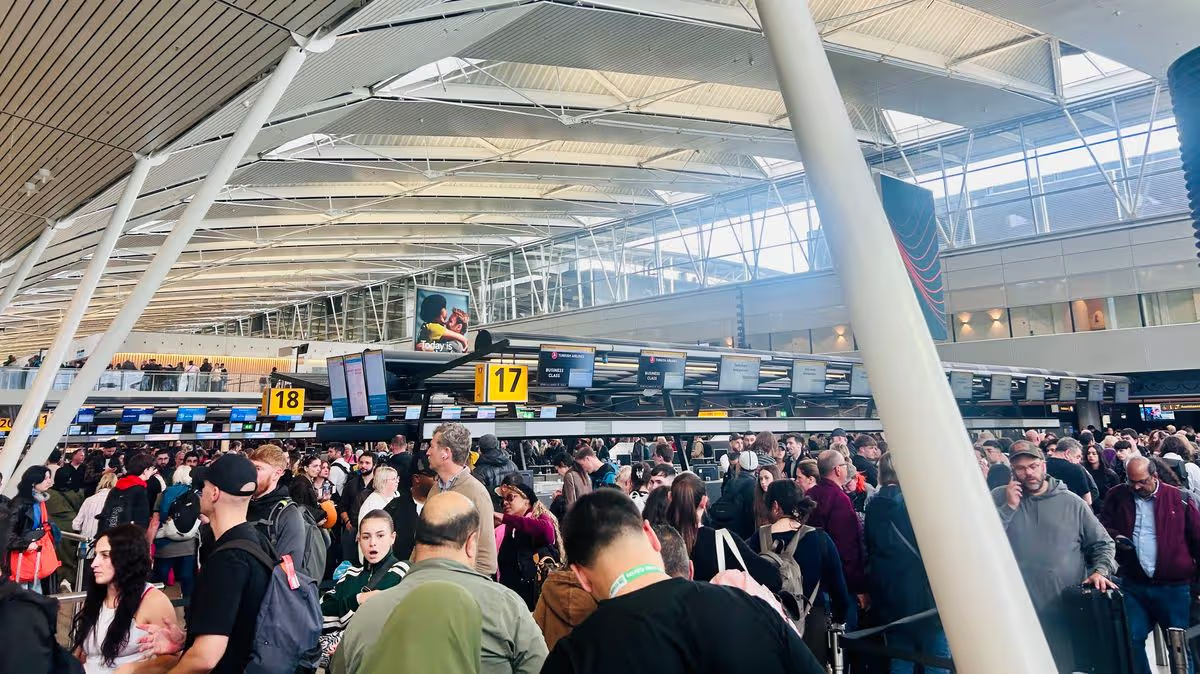
Queues at Amsterdam Airport Schiphol earlier this week(Image: Manchester Evening News)
Earlier this week, Amsterdam’s Schiphol Airport experienced widespread disruption as severe security queues and new border control procedures led to long delays and passenger frustration.
Hundred of flights were delayed as long lines formed at security checkpoints across the airport’s terminals. In some departure halls, no sooner had passengers checked in hold bags than they were queuing around check-in counters just to scan their boarding passes – all before queuing for the security bag checks.
Standing amongst those waiting on Monday afternoon, I couldn’t help think ‘is this a sign of things to come’? I’d been on alert to potential disruption since the weekend when easyJet emailed me to advise me to arrive early.
Click here to get the biggest stories straight to your inbox in our Daily Newsletter
The email explained that the airport would be busier than usual and to make sure to leave enough time to arrive at my gate. It added: “If you have a bag to drop off, we recommend arriving when bag drop opens for your flight.
“Either 2.5 hours before your scheduled departure if your flight is to a destination within Europe (excluding the UK), or 3 hours before your scheduled departure time if your flight is to the UK or a destination outside of Europe.”
Because the email did not go on to to explain why the airport would be busier than usual, I started to think it might have something to do with the new Entry-Exit system (EES).
EES became fully operational across Schengen zone borders as of April 10, which means UK travellers will now need to supply additional data such as fingerprints and a photograph to create a digital record when visiting destinations in this area, such as Spain and Greece. It is valid for three years.
The system is designed to replace passport stamping and will monitor visa-free travellers to ensure that they do not stay any longer than 90 days within any 180-day travel period. Some travellers may have already encountered the changes, as the system began being rolled out in October last year.
Introduced by the EU, it is designed to improve border security and reduce illegal migration. However it has encountered several issues with airports within the Schengen Area struggling to cope with the additional administration, and has at times resulted in long queues and passengers missing their flights.
In total, it took me just over one hour and thirty minutes to scan my boarding pass, have my bags checked and clear border control. Fortunately I’d followed the airline’s advice and arrived three hours early, giving me enough time before boarding, but a few of my fellow passengers came rushing onto the plane sweating – presumably caught up in the queues.
As it happens, the airport attributed the disruption on Monday (May 18) to the major restructuring of Schiphol’s security operations. This week, the airport has reduced the number of security contractors from three to five, with newly created companies taking over operations.
I found this out via some back-and-forth emails with the airport and scanning Dutch news website. But for the average person, this information wasn’t all that accessible, further cementing the confusion at the airport on Monday. Staff were friendly, handing out water and Stroopwafels – the latter a traditional Dutch treat – but couldn’t do much more in terms of assistance or estimates on wait times.
When I dug further to see if the delays on Monday included the implementation of the EES systems, the Royal Netherlands Marechaussee, which is the national gendarmerie and military police force of the Netherlands who handle the border checks, informed me that the EES procedure is currently not yet fully operational at Schiphol and is being rolled out in phases, and that the delay was down to the change of security process at Schiphol.
Heading further down this rabbit hole, communicating with the airport, airlines and military police, it struck me that there is a lot of potential this summer for confusion around any form of delays – be it due to the new exit-entry system rollout or airport’s individual issues.
For example, there’s been a great deal of coverage around whether Greece will suspend the biometric checks for British visitors in light of the growing airport congestion. Other countries including Portugal and Italy seemed to be teeing it up too, though none have officially suspended it.
It’s a real concern for those jetting off to Europe this summer too. Almost half of British holidaymakers are worried they will miss their flights this summer due to border checks, a new survey by travel company Booking.com has found.
The new survey found that nearly three out of five (59per cent) of UK holidaymakers travelling to Europe this year expect delays linked to the EU’s entry-exit system. Representative body Airports Council International recently reported that EES was causing delays of up to three hours, with airports in Spain, Portugal, France and Italy among the worst affected.
In April, more than 100 easyJet passengers missed a flight from Milan Linate to Manchester because of delays at passport desks caused by the ramp up of EES. The survey of 2,000 UK adults, conducted by research company Opinium between May 8-12, indicated that 56per cent of UK travellers plan to arrive at airports earlier than usual in an attempt to avoid disruption, with 12per cent intending to arrive at least four hours before departure.
The issue underpinning the new system is that the passenger experience is a lottery. More than half (52 per cent) of respondents who have travelled to the EU since the introduction of EES said they experienced delays during their journey, while 43 per cent said they were not delayed.
One of my colleagues was surprised by how seamless the new system was when travelling with her young family to Malaga recently. The queue at the machines to take pictures and fingerprints was short and moved very swiftly.
The staff proved to be very helpful and the whole process took about three minutes. And as she helpfully points out for those travelling with kids, children under 12 are exempt from providing fingerprints but must still undergo a facial scan.
Though as she points out about the return home, you must pass through the border again and that bit comes after the security checks. The gate is at some airports where the checks take place and may explain why some people have been caught out when travelling home.
As Schiphol demonstrates though, the extent to which the new system is incorporated, or whether it is suspended is not always known by passengers. Delays are sadly an inevitable part of travel, but the fear of missing a flight is a real one, especially when the implementation has so far been patchy at best.
Below we’ve outlined how to the new system works in principle and answered some of the frequently asked questions so that you have the necessary information when travelling through the airports where EES is now being used this summer.
What data will I supply for my ‘digital record’?
The EES requires UK travellers to register their biometric information when entering the Schengen area. This will mean holidaymakers will now have to have their fingerprints scanned and their photograph taken when arriving in a country operating EES.
UK travellers will also need to answer questions about their visit, such as whether they have somewhere to stay, enough money for their trip and a return ticket. Passengers may also be required to provide either their fingerprint or photo when exiting the Schengen area.
When will I be asked to create a ‘digital record’?
Holidaymakers will be asked to create their ‘digital record’ when arriving at an airport or port in the Schengen area. For most UK travellers the EES process will be done at foreign airports.
As part of the EES, travellers may be asked to submit their fingerprints and have their photo taken in dedicated booths. No information needs to be supplied before travelling to a Schengen area country, and all details will be taken on arrival.
Who does EES apply to?
The EES will apply to anyone visiting or leaving one of the 29 countries in Europe’s Schengen area. This is mostly the EU plus Iceland, Liechtenstein, Norway and Switzerland.
All travellers must supply their biometric data, including having both their photograph and fingerprint taken. Children must also register, however under-12s will be exempt from fingerprinting.
Will there be disruption?
EES was first introduced in October last year, with its roll out ramped up on April 10. EU rules currently allow the checks to be temporarily halted to avoid queues at peak periods.
The Home Office has said EES may take “slightly longer” than previous systems, and has advised travellers to “be prepared to wait during busy times”.
EES registrations last for three years and any subsequent border crossing within that period will require an individual’s fingerprints and photograph to be verified. However this process is expected to be quicker than initial registration.
If you miss your flight due to EES queues, who is responsible, and can you claim?
According to advice on the UK Civil Advice Authority (CAA) website, if you miss a flight due to a long queue at security, even though you arrived at the airport on time, it is unlikely that an airline would pay compensation or consider itself obliged to offer you a free alternative flight.
It does note that some airlines are helping their passengers find alternative flights voluntarily though. It also recommends contacting your travel agent or airline to help book you onto an alternative flight, but you may need to pay extra to do this.
A spokesperson for the Association of British Insurers (ABI) also said: “Longer wait times are expected as the Entry/Exit System (EES) comes into effect and we’d encourage customers to plan in advance and be prepared for possible delays.
“Travel insurance is unlikely to cover losses from delays caused by EES queues so if you miss your flight, or other parts of your trip, it’s best to speak to your airline, accommodation provider or tour operator in the first instance.”
Government advice for EES
The government website details the new requirements and adds that on your first visit to the Schengen area, you may be asked to create a digital record at the port or airport on arrival. You may be asked to submit your fingerprints and have your photo taken at dedicated booths.
You don’t need to provide any information before travelling to a Schengen area country. You may also be asked to provide either your fingerprint or photo when you exit the Schengen area.
It adds that the checks may take slightly longer than previously, so be prepared to wait during busy times. It tallies with the general advice to arrive in plenty of time this summer.