
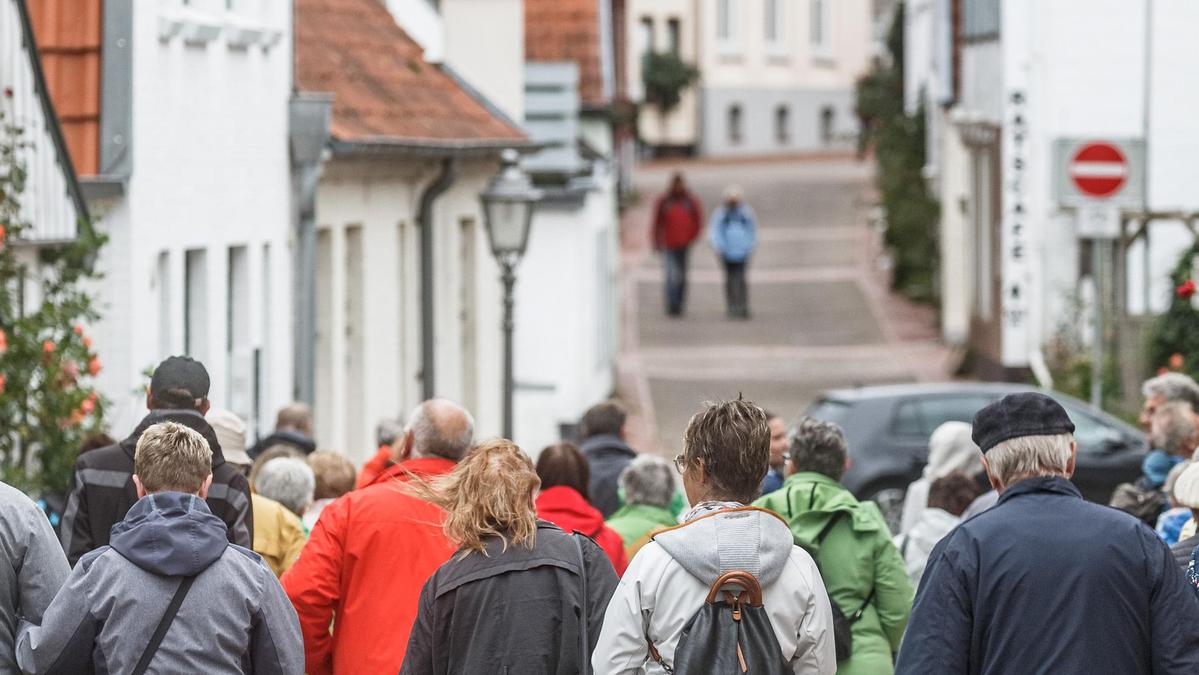
On every tour, there will be those at the front and those at the back.
And a reader raises the important point that, as someone who moves more slowly, she carefully chooses “leisurely” paced tours.
She’s careful to do this, so she doesn’t hold groups up.
But she makes the point that fast walkers are on the same tours, and that seems to set the speed, so the slower people are often left behind.
She particularly responds to a story we published on Saturday, May 16, in which we said: “Those who still thought themselves fit (when clearly they are not), were also looked after when they flagged and gave up halfway.”
Our reader, who wishes to remain anonymous, writes: “I wish to put another side to this opinion.”
And we give her the opportunity to do this…
ANOTHER POINT OF VIEW
I am in my mid-80s, healthy, and bring a folding mobility scooter and a folding walking stick to keep up with the group and to avoid tripping over in unfamiliar territory.
Before booking, I choose the lowest level of activity, usually “leisurely”, then read every word about the distances, times, number of steps and so forth. Then I phone the tour agency to confirm these details. I tell them about the speed at which I walk, my scooter and walking stick, and the time I can spend standing or walking. Only once this is confirmed do I book.
An example is last year, my husband and I went to Japan on a Trip a Deal bus tour.
The guide looked at my walking stick on the first day and gave me a lecture about how everyone (even the disabled?) in Japan walk everywhere.
She then took off at a brisk walking speed, leaving me on my scooter (crowd pushed in between me and her) and another lady, who was on crutches, far behind.
She came back for us, hurrying us up.
When we arrived at a temple, it had far more steps than in the tour description.
The other lady and I were told “go over there”. We did, and found ramps and disabled toilets. Perhaps we could have got further up the side of the temple from there, but there was no assistance.
On the way back to the bus, the other lady got lost, so the guide had to look for her. She, too, had checked whether the tour was suitable for her!
Many times, the guide would not let me scooter along beside her but left me behind to be swamped with other tour groups.
This was repeated in several other places. No guide with us — we were left to our own devices.
When I spoke to the guide, she had no idea of the steps etc described in the tour brochure, and which I had checked.
The guide was the worst we have ever had, so received a minimal tip. The bus driver was wonderful, always having my scooter out first. He was generously rewarded.
Tour organisers are so keen to fill their tours that they take all comers, including the very fit fast walkers, on “leisurely” or other low-level activity tours.
Many people, I am sure, do not read the full description of the tour activity.
These fit fast walkers do not understand those who walk slowly have chosen the tour because of this, not because they necessarily have over-estimated their fitness.
Tour organisers need to be more up-front about the speed, distances and steps, and discourage fitter, faster people from taking over the tours.
All guides need to be notified clearly about the level of fitness for the tour, and not push people beyond this, as our guide tried to do.
Name & details supplied
EDITOR’S COMMENT
I note every point raised here. A lot of the issues you raise are things I think about very often. Through our own small venture into tours, I am personally aware of such issues, and always very keen that those with reduced mobility join us and are looked after not only respectfully, but in such a way that they can fully enjoy their time.
We publish this to maintain my focus on these important issues.
Stephen Scourfield