
Travel officials in Spain have given a new warning that affects three top travel spots popular with Brits heading abroad

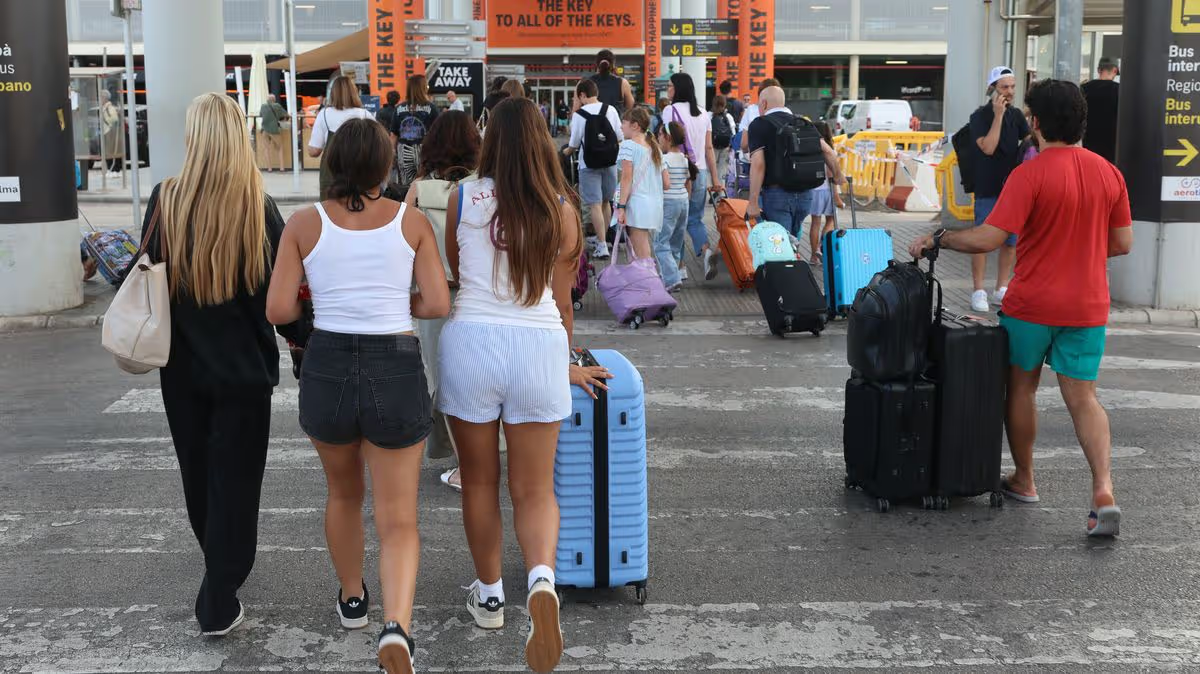
Officials have issued an update for tourists heading to destinations such as Mallorca – pictured are travellers at Palma de Mallorca Airport in Palma, Spain last year(Image: Getty)
Holidaymakers heading to Spain this summer have been warned over airline ticket prices. The alert follows warnings that the Iran conflict is putting considerable pressure on global jet fuel supplies for airlines.
These mounting challenges have already led some carriers to reduce their planned flight schedules, with the impact now being seen in rising ticket costs. Industry leaders are warning of further difficulties ahead for travellers visiting some of Britain’s most favoured holiday destinations as the busy summer period draws near.
The latest caution has come from travel agents in Spain. The Balearic Islands Travel Agencies Association (AVIBA) has advised those planning trips to sought-after locations such as the three hotspots of Mallorca, Menorca and Ibiza to prepare for higher ticket costs – though it has confirmed that flight numbers to these islands are not anticipated to be cut.
Spanish media reports indicate that AVIBA president Pedro Fiol has cautioned that ticket costs will unavoidably increase substantially due to financial strain caused by the conflict. He has warned that the war is set to create a summer “with a context of greater tension and rising costs that will be gradually passed on to ticket prices”, according to Spanish publication Ultima Hora.
Nevertheless, he emphasised that the profitability of routes serving the Balearic Islands means it’s improbable that flights to these destinations will be cancelled. He did, however, acknowledge that this scenario could potentially occur during quieter periods outside the peak season.
AVIBA has observed that airlines are presently exercising “a certain restraint” when it comes to ticket pricing. However, the president cautioned that fuel shortages and rising costs, triggered by the Iran conflict, will inevitably lead to increased airfares. The Airline Association (ALA) has issued a comparable warning, reports the Mirror.
Yesterday, Lufthansa announced the cancellation of approximately 20,000 flights extending through October as part of its operational restructuring. The airline clarified that these cuts affect unprofitable operations, though none are based in Spain. The approach aims to redirect capacity towards the most profitable routes.
Mr Fiol stated: “We don’t foresee a summer with planes grounded due to a lack of fuel, but we do anticipate a more complex and price-driven environment.” Spanish website INB3N reports that Mr Fiol also raised concerns that additional flights might be forced to make unscheduled stops for refuelling during journeys.
Earlier this week, TUI disclosed that the Iran conflict cost the company roughly 40 million euros (£34.8 million) last month following the repatriation of thousands of holidaymakers and employees. Europe’s largest travel firm reduced its profit projections and suspended revenue guidance as a result, leading to a drop in its share price. The company is among travel firms that have experienced significant disruption due to the Middle East conflict, which began at the end of February. It also joins other airline operators facing pressure from rising jet fuel costs, as the conflict has pushed up oil prices.
However, holidaymakers should have “no worries” about flights being cancelled this summer, despite airlines grappling with a “triple whammy” resulting from the Gulf conflict, according to a former industry boss.
Tim Jeans, previously commercial director at Ryanair and later managing director of Monarch Air, suggested that while there “may be some trimming of schedules” by airlines, he doesn’t anticipate carriers axing routes completely.
His comments come after serious warnings from the trade body representing European airports, which alerted authorities that a “systemic” jet fuel shortage could materialise before the peak summer season if the Strait of Hormuz remains closed in the coming weeks.
Airports Council International, representing over 600 airports, recently contacted European commissioners for energy, transport and tourism, cautioning that unless the crucial strait reopens in a “significant and stable way within the next three weeks” then “systemic jet fuel shortage is set to become a reality for the EU“. Director-general Olivier Jankovec warned: “The fact that we are entering the peak summer season… is only adding to those concerns.” Nevertheless, Mr Jeans maintained: “I don’t see a situation where flights will get cancelled because of the non-availability of fuel.”
He recognised that airlines are currently facing a “triple whammy for airlines at the moment”, highlighting “the issues in the Middle East which has caused a massive spike in the cost of fuel”.
During an interview on BBC Radio Scotland’s Breakfast programme, Mr Jeans explained: “That in turn is pushing up ticket prices, and the uncertainty around whether it is going to be possible to travel, plus the increase in prices is reducing demand.
“And so you have a situation where airlines are looking at their bookings for the next three months ahead and saying ‘should we fly that flight, is it going to be profitable?'”