
With many UAE trips planned for Easter and the busy summer holidays British travellers are wondering when it will be safe to travel to Dubai

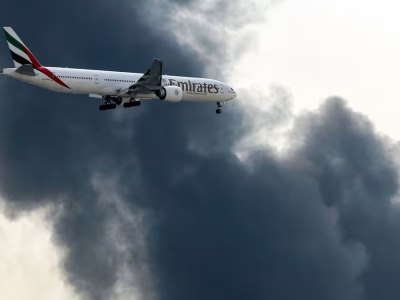
The conflict continues to create severe travel problems(Image: FilippoBacci via Getty Images)
More than a million British tourists travel to the UAE each year for holidays in Dubai and Abu Dhabi with 1.3m British tourists visiting Dubai alone in 2025. After US and Israeli strikes on Iran led to the closure of Gulf airspace on February 28 airspace across the Middle East was shut causing thousands of flight cancellations.
The conflict continues to create severe travel problems outside the Middle East as it’s a major connection hub for flights to destinations like southeast Asia and Australia.
The Foreign, Commonwealth, and Development Office (FCDO) has issued travel warnings for 31 countries, saying: “Escalation in the Middle East has caused widespread travel disruption including airspace closures, delayed and cancelled flights. Your travel plans may be affected even if your destination is not in the Middle East.” Stay in the know by making sure you’re receiving our daily newsletter.
With many UAE trips planned for Easter and the busy summer holidays British travellers are wondering when it will be safe to travel to Dubai and if their holidays will go ahead.
Currently the FCDO continues to advise against all but essential travel to the United Arab Emirates, including Dubai, due to ongoing Iranian strikes on civilian infrastructure in the region.
UK authorities cite serious security risks such as missile and drone attacks with airports and hotels previously targeted.
The FCDO advice, as of April 1, reads: “Regional escalation poses significant security risks and has led to travel disruption.
“Stay away from areas around security or military facilities and US or Israeli facilities and institutions. Iran continues to strike civilian infrastructure across the region such as ports, hotels, roads, bridges, energy facilities, financial institutions, oil production sites, water systems, and airports.
“Follow the instructions of the local authorities and monitor local and international media for the latest information.”
Travelling against this official advice will likely invalidate your travel insurance. Authorities strongly recommend British, Irish, and Australian citizens in the UAE to consider leaving if they can do so safely via the limited available commercial flights
The disruption for British tourists has been significant. About 104,000 Britons registered with the Foreign Office for help in the early days of the conflict and the government said hundreds of thousands of UK citizens were in the affected region.
Thousands of British nationals have been stranded in the United Arab Emirates, including Dubai, because of the conflict between the United States, Israel, and Iran.
In March the FCDO said about 141,000 British nationals in the Gulf region had registered with the UK Government for updates of whom 112,000 were in the UAE.
Dubai International Airport (DXB) faces ongoing safety concerns with drone strikes disrupting air travel over the last few weeks.
Although a few flights have resumed most major airlines, including British Airways, Lufthansa, Virgin Atlantic, and Wizz Air, remain suspended for routes to Dubai and the wider region. These suspensions vary by airline and destination with most extending for several months.
Regional airlines have added extra flights to help stranded passengers in the UAE using narrow air corridors monitored by military jets.
It is still unclear when the FCDO will change or lift its current travel advice for the UAE.
Before you travel check the latest FCDO travel advisories. If you travel against FCDO advice, especially when it is “all but essential travel” or “no travel,” your travel insurance may not be valid.
Insurers usually consider this a high-risk situation so they are unlikely to pay claims for medical treatment, cancellations, or repatriation. Check your policy now to make sure you are still covered.