
For years Brits have hopped across to Europe for their summer holidays, whether it’s for a camping trip in France, a sunshine holiday in Spain or an island-hopping adventure in Greece.
Crossing the European border used to be a smooth experience back when we were in the EU, but now we’re subject to the latest entry requirements which have launched this year, the Entry/Exit System (EES). Under these rules third-country nationals such as ourselves are required to provide biometric data – fingerprints and photographs – at the border, creating a digital record.
This will then be valid for three years and will replace passport stamping. The aim is to boost border security and efficiency, although the rollout of the system has been far from smooth.
Click here to get the biggest stories straight to your inbox in our Daily Newsletter
Many passengers have experienced long delays at the EU border due to faulty EES kiosks, with some even missing their flights due to the lengthy queues. This hasn’t been the case for everyone, though – in fact the EES appears to be very hit and miss, with lots of holidaymakers breezing through the system.
As the M.E.N’s tourism writer, I’ve covered the EES extensively, yet I hadn’t experienced it first hand myself until I went on holiday to Ibiza earlier this month. Aware of the lottery of experiences passengers have reported, I was intrigued to see how it would pan out.
Having departed Manchester Airport on an eye-wateringly early Jet2 flight at around 6.30am, we touched down in Ibiza at roughly 10am local time. Aware that there could be long queues at arrivals, I was armed with snacks and plenty of water, yet I was pleasantly surprised at the system.
We were directed to the non-EU arrivals queue and lined up to use the EES kiosks, only waiting a few minutes for one to come free. There were quite a lot of passengers behind us so perhaps we were lucky.
Using the kiosks was easy enough with clear instructions on the screen and staff on hand to help. We had to provide fingerprints and a photograph, the full EES experience. The only thing that was confusing was how long the machines took – for example after you scanned your passport there would be a long wait until the screen said it was ready to proceed.
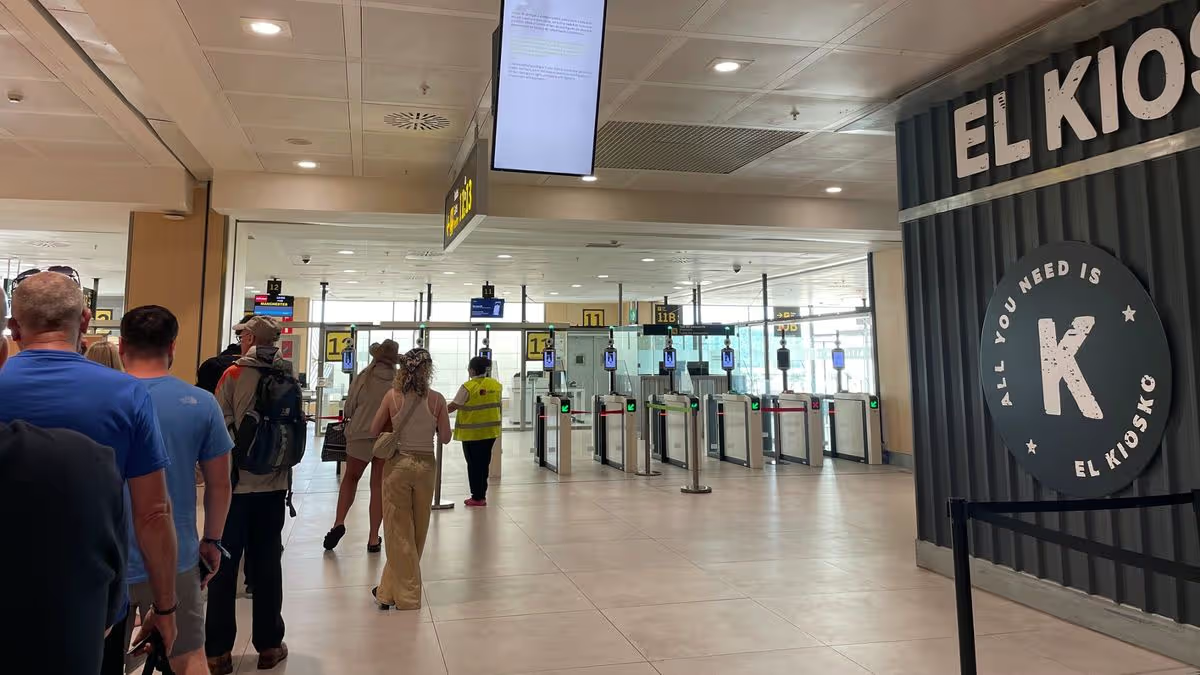
In reality this was probably only a minute’s wait at most but, as is this case with any airport experience, it always feels longer than it is. Eventually the screen came up with the message that you’re free to proceed to passport control, a simple e-gate which worked seamlessly for me. Overall the whole experience took around 15 minutes from entering the terminal building.
Six days later, after a glorious time of snorkelling and sunbathing, we arrived back at Ibiza Airport for the return journey. As we were on a package holiday with a coach transfer booked, we had no control over what time we would arrive at the Airport.
We also had bags to check in, so we couldn’t arrive any earlier than the bag drop opening anyway. Fortunately our coach pulled up at approximately 9am, a good two hours before our departure at 11.15am.
Check-in was smooth with minimal queues, and aside from a short wait for trays to become available, security was a breeze. When we arrived airside our gate hadn’t been announced yet, so we went in search of refreshments – I will say Ibiza Airport is perhaps one of the best I’ve flown from in Europe in recent years, compact yet plenty of food and drink outlets, shops and seating.
Now this is the part I think is key to the EES experience. You need to keep your eyes on the departure board so you can see immediately when your gate is announced. Once it is, head there straight away so you stand the best chance at getting to the front of the queue.
When we arrived at our gate queues were already forming at passport control, which hadn’t yet opened. Those who spent too long lingering in duty free would have found themselves at the back of the queue.
This part was slightly chaotic as there were several gates close together, with another flight departing to Bristol next to us and a separate lane for families which had a manned passport control kiosk, so a few passengers were not sure which queue to join. But once the kiosks opened we filed through relatively quickly.
This time we only had to scan our passport and have our photo taken, no fingerprints. Once you have done the initial EES registration chances are you will only have one set of biometric data taken after that, usually a photograph. So in theory, after you’ve registered for the EES initially, subsequent visits should be quicker, although that does depend on the airport you’re at.
Overall, I was pleasantly surprised by how quickly we were moved through. It only took around 15 minutes from arriving at the gate to exiting passport control. However, this may have been helped by how small Ibiza Airport is.
My key piece of advice from my experience is to monitor the departures board closely and make sure you arrive at your gate as soon as you can.
Below we’ve outlined how the new system works in principle and answered some of the frequently asked questions so that you have the necessary information when travelling through the airports where EES is now being used this summer.
What data will I supply for my ‘digital record’?
The EES requires UK travellers to register their biometric information when entering the Schengen area. This will mean holidaymakers will now have to have their fingerprints scanned and their photograph taken when arriving in a country operating EES.
UK travellers will also need to answer questions about their visit, such as whether they have somewhere to stay, enough money for their trip and a return ticket. Passengers may also be required to provide either their fingerprint or photo when exiting the Schengen area.
When will I be asked to create a ‘digital record’?
Holidaymakers will be asked to create their ‘digital record’ when arriving at an airport or port in the Schengen area. For most UK travellers the EES process will be done at foreign airports.
As part of the EES, travellers may be asked to submit their fingerprints and have their photo taken in dedicated booths. No information needs to be supplied before travelling to a Schengen area country, and all details will be taken on arrival.
Who does EES apply to?
The EES will apply to anyone visiting or leaving one of the 29 countries in Europe’s Schengen area. This is mostly the EU plus Iceland, Liechtenstein, Norway and Switzerland.
All travellers must supply their biometric data, including having both their photograph and fingerprint taken. Children must also register, however under-12s will be exempt from fingerprinting.
Will there be disruption?
EES was first introduced in October last year, with its roll out ramped up on April 10. EU rules currently allow the checks to be temporarily halted to avoid queues at peak periods.
The Home Office has said EES may take “slightly longer” than previous systems, and has advised travellers to “be prepared to wait during busy times”.
EES registrations last for three years and any subsequent border crossing within that period will require an individual’s fingerprints and photograph to be verified. However this process is expected to be quicker than initial registration.
If you miss your flight due to EES queues, who is responsible, and can you claim?
According to advice on the UK Civil Advice Authority (CAA) website, if you miss a flight due to a long queue at security, even though you arrived at the airport on time, it is unlikely that an airline would pay compensation or consider itself obliged to offer you a free alternative flight.
It does note that some airlines are helping their passengers find alternative flights voluntarily though. It also recommends contacting your travel agent or airline to help book you onto an alternative flight, but you may need to pay extra to do this.
A spokesperson for the Association of British Insurers (ABI) also said: “Longer wait times are expected as the Entry/Exit System (EES) comes into effect and we’d encourage customers to plan in advance and be prepared for possible delays.
“Travel insurance is unlikely to cover losses from delays caused by EES queues so if you miss your flight, or other parts of your trip, it’s best to speak to your airline, accommodation provider or tour operator in the first instance.”
Government advice for EES
The government website details the new requirements and adds that on your first visit to the Schengen area, you may be asked to create a digital record at the port or airport on arrival. You may be asked to submit your fingerprints and have your photo taken at dedicated booths.
You don’t need to provide any information before travelling to a Schengen area country. You may also be asked to provide either your fingerprint or photo when you exit the Schengen area.