
I was stopped at border control and warned I would be faced with a fine

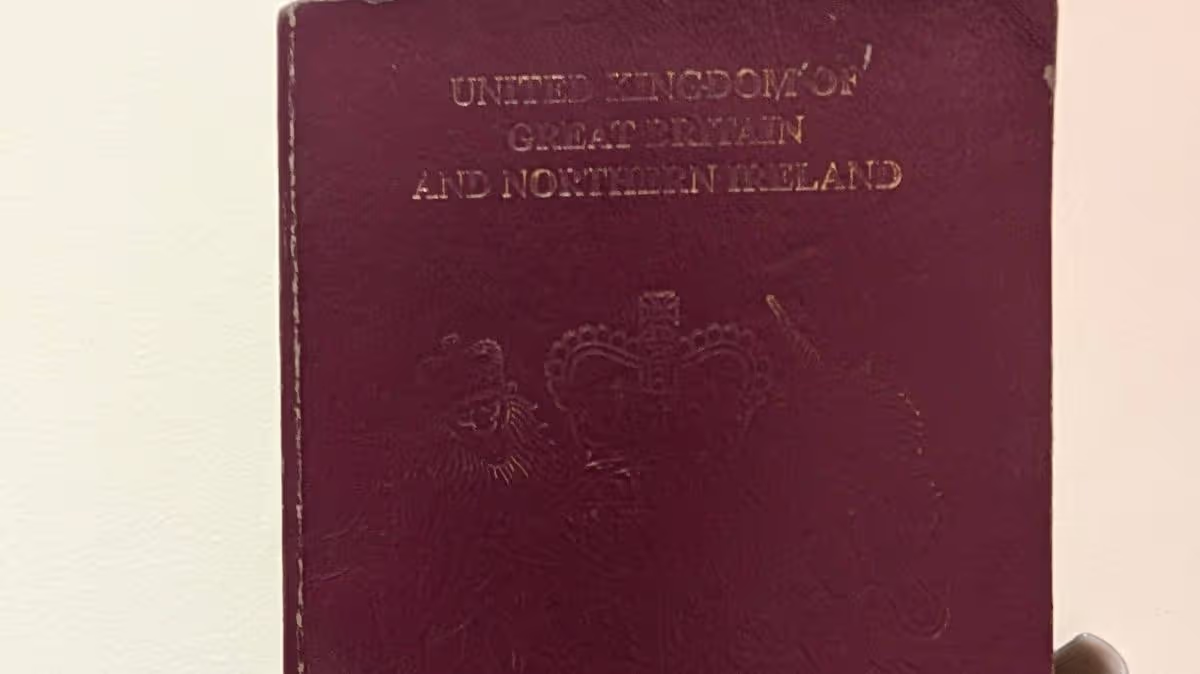
I was warned I could get a fine the next time I travel(Image: Shania King-Soyza)
By this stage, I’d consider myself a seasoned traveller. Having explored nearly every continent over the last two years, my journeys have generally been trouble-free—until a recent experience. Earlier this month, I made the trip to Los Angeles, California.
However, with steep ticket costs, it proved more economical to route through Europe before continuing to the States. The itinerary seemed straightforward: a two-hour flight to Munich, Germany, followed by a two-hour stopover, then onwards to LAX.
This wasn’t my maiden voyage into Germany, nor my first visit to a European nation since considerably stringent travel protocols came into force.
On 12th October 2025, the European Union launched the Entry/Exit System (EES). As outlined by Gov.uk, this represents a “new digital border system that has changed requirements for British citizens travelling to the Schengen area.”
“[The] EES is designed to improve border security within the EU and its neighbouring countries, and reduce illegal migration in the Schengen area. It automates border control checks to help the EU stop visitors [from] overstaying.”
Following the EES rollout, I’d ventured to Luxembourg (once during November 2025) and the Netherlands (on two occasions in 2026), encountering no difficulties whatsoever upon entry.
Yet my Munich transit proved extraordinarily nerve-wracking. Though spared the need to provide fingerprints or have my photograph taken, I faced the potential denial of onward travel to the States and the prospect of a penalty, all down to a single item: my passport.
Now, numerous readers might be pondering, “What on earth is the problem?” and “Should I worry? Well, to be honest, the answer is complicated: yes…and no. I am a certified numpty, but hear me out.
Before 2023, I had not left the UK, so travelling was a foreign idea to me, which I had not expected to ever experience. After losing my provisional license on a night out, I opted to use my passport for any ID needs.
My reckless younger self forgot to check her pockets before washing and tumble-drying her British passport. Luckily, my passport came out relatively unscathed, with just a few wrinkly pages, small tears at the bottom, and a faded front cover, but no major damage.
My photo, biometric data, and information are still clear and identifiable, and fortunately, I have been able to travel to eight countries since then, with it being a little running gag in certain places that my passport has clearly been in the washing machine.
However, my stopover in Munich was quite confrontational. The gentleman at the little border control before you are allowed to proceed to the waiting area stopped me.
He declared: “Miss, I am allowing you to enter this time, but I am going to put your name in the system.” He went on to clarify: “Your passport needs to be changed, so once you get to the UK, you need to get a new one. If you attempt to travel with this passport again, you will be fined.”
My heart sank completely. Admittedly, I’m conscious my passport has seen better days, but by this stage, I’d successfully passed through Hong Kong, Shenzhen, Marrakesh, and Amsterdam—stringent locations where I’d anticipated potential difficulties, yet encountered none.
Thus, it came as quite a shock that my adjacent nation raised objections. According to Gov.uk, a damaged passport is one that cannot serve as valid identity proof due to its condition.
Such damage may encompass:
- When the personal details or observation page are unreadable
- Laminate peeling or lifting away from the personal details page
- Unreadable security details
- Missing or detached pages
- Where the front, back or personal details page has been cut
- Damage or discolouration to any part of the passport caused by water, chemical or ink spills, tears, rips, or bite marks
Nevertheless, given my repeated success while travelling, I’d presumed my passport merely exhibited typical wear and tear. Indications of standard wear and tear include:
- The personal details page of the passport is legible (readable)
- There is no obvious trace of amendments or tampering
- The binding is intact
- The laminate is secure
- There are minor tears around the edges of pages or the cover (indicating normal use)
- There is only slight water damage to the page edges (crinkling or curling)
- There are minor scratches on the personal details page on a blue e-Passport
- The personal details page is bent on a blue e-Passport
Irrespective of my personal assessment regarding my passport’s condition, carriers hold ultimate authority. As Booking.com notes: “Airlines have a responsibility regarding passport conditions.
“If they allow you to fly with an invalid document and you’re denied entry on arrival, they may face fines and costs for your return journey. That’s why gate agents sometimes refuse boarding even when the damage appears minimal. If you do make it onto your flight, border control at your destination has the final say.
“Their assessment is decisive: If your passport appears compromised, they may detain you briefly, refuse entry, and require you to return on the next available flight. This could mean disrupted travel plans, financial losses, and significant inconvenience.
“Whilst a damaged passport might not prevent you from boarding a plane, it can certainly prevent you from entering a country.”
Despite this, entry into the United States was granted without complications, allowing for an enjoyable holiday. The return journey home proved equally smooth, though such risks won’t be taken again. Take note of this experience and exercise additional caution when travelling in future.