
Benjamin Wong has found peace — at 8,530 feet.
As a high school teacher in Singapore, he gets long summer breaks, but he struggles to find places to travel to that aren’t as unbearably hot as where he lives.
This summer, he is camping out at a luxury mountain lodge in Yunnan, a region of southwestern China that has become more popular with tourists looking for places to escape the heat. Dali and Lijiang, well-visited cities in Yunnan, can be as cool as 59 degrees Fahrenheit at night in the summer — a major deciding factor for Wong.
“Other than weekend getaways to neighboring Southeast Asian cities, all my other holidays are always to places cooler than Singapore,” says Wong of the humid city-state, where temperatures routinely hover above 80 F. “Europe is unpredictable of late, and the last thing I want is to fly 13 hours and suffer in a heat wave with temperatures higher than Singapore’s.”
Wong’s decisions may be personal, but they underscore a deeper trend around the world. Some travel experts have been using the buzzword “coolcations” to describe a vacation location chosen for cooler weather. And it isn’t only the tourists coping with the dangerous weather. About 75% of workers in Asia are exposed to extreme heat, including employees like food vendors and delivery drivers, who often cater to tourists, according to the World Meteorological Organization.
Last month, temperatures in France soared to 104 F as a “heat dome” enveloped the country. In an unprecedented move, Paris officials asked organizers of the annual summer music festival Fete de la Musique not to sell alcohol, as dehydration and heat stroke were serious risks to attendees. In Spain, the UK, and Switzerland, temperatures hit all-time highs, prompting many outdoor attractions to close or restrict their hours.
In Asia, the situation is also dire. The continent is warming twice as fast as the rest of the world, according to the WMO. In Japan, two new records seem to be broken every year: international visitors and heat, with an all-time high temperature of 107.2 F.
All five of the hottest days on record in Japan happened last summer. It prompted the country to coin a new word: kokusho-bi, or cruelly hot day.

While some travelers have pivoted to traveling during shoulder seasons, it’s the northern hemisphere summer that dominates travel due to school schedules, with multiple countries in Asia also giving students extended breaks over the June-August period. The combination of relentless heat and floods of human traffic can make conditions downright unbearable.
One solution for those visiting hot destinations is to go to outdoor attractions in the early morning or evening. Travel experience booking platform Get Your Guide tells CNN Travel that they’ve added more nighttime activities to meet these demands.
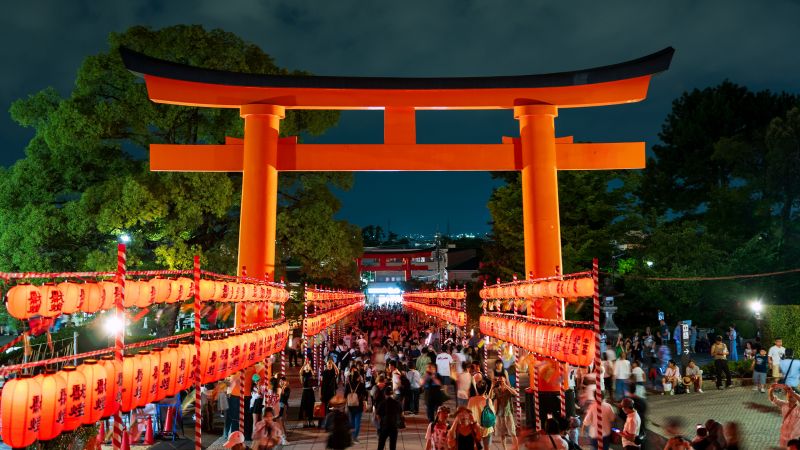
In Asia, these “dusking” experiences can include a nighttime tour of Kyoto’s social media favorite, the bright-orange Fushimi Inari shrine, a sunset sail on the Mekong River in Thailand, or a spooky ghost-story tour of Seoul’s backroads. Bookings for activities in the 5-9 p.m. range are up 30%, the rep says, and Asia is the biggest market with a 70% uptick.
Takao Nishina, who is the Japan and South Korea manager for Get Your Guide, says it’s first-time visitors and the obsessive bucket listers who are most willing to push through extreme heat to cross items off their itinerary. For the extreme travelers who are spending more time flying to a destination than visiting it, suffering through the weather is just part of the adventure.
Now, he’s working to craft options that keep everybody happy — for example, moving cooking classes from an open-air market to an indoor venue, or encouraging sumo stadiums to have their tours during peak sunshine hours so people doing full-day itineraries can do outdoor stuff in the morning instead.
Brian Yung, a Hong Kong native who works in marketing, thinks he was taking “coolcations” without realizing it.
In the past few years, Yung vacationed in Finland, Denmark and Canada. He also visits Japan, his favorite destination, a few times a year, but has swapped Tokyo and Osaka for smaller, mountainous regions.
“I love Yamagata. I went in the winter and it was actually cold. It felt colder there than in Finland, which was wild to me.”
“I’m always thinking about how can I get out of the heat and the humidity,” Yung says. “I feel like subconsciously I’ve been choosing places that are cooler.”

While it may sound shocking to think anybody is “winning” from climate change, there are some parts of the world that have seemingly benefited from it — at least when it comes to the tourism industry.
Raymond Rastegar, a professor of hospitality at Australia’s Griffith University, specializes in how climate change affects the way people travel. New Zealand’s South Island, Mongolia, Kazakhstan, Japan’s Hokkaido and Tasmania in Australia are some of the places experiencing a tourism boom in part due to their pleasant June-to-August weather.
Mongolia’s state tourism agency reported a 33% increase in visitor numbers in the first half of 2026. The country is investing in more hotels and attractions in capital city Ulaanbaatar, anticipating that number will go up in the years to come. Tasmania recorded its busiest winter travel season ever in 2025, with about 250,000 visitors coming during the June-August period, up 7% from the year before.
But seasonality isn’t just about heat. Changing typhoon patterns can result in rainy seasons being longer than in the past, and extreme humidity can turn a warm day into an insufferable one.
“Climate variability is reshaping both travel behavior and operational planning,” says Namgyal Sherpa, CEO of Sherpa Hospitality Group in Nepal.
“Demand is spreading across a longer operating window with reduced seasonality gaps.”
As a result, employees at the group’s hotels, like the upscale Shinta Mani Mustang in northern Nepal, have to do risk assessments all year round and plan for every potential weather-related risk. Some popular hiking trails, for example, are now inaccessible for long periods because of rising water levels.
Even a traveler who does their research might not be prepared for extreme weather in real time.
“One of the biggest challenges now we have is lack of awareness when it comes to travelers, especially when they travel to other destinations, because they are not familiar with the climate, how hot it may get, so they are very vulnerable,” says Rastegar.

Ironically, some of the places suffering the most from climate change are those experiencing “last chance tourism.”
This movement is motivated by the desire to visit places before they’re gone forever — like going to the islands of the Maldives before they erode into the sea or the Great Barrier Reef as it faces significant coral bleaching. In these cases, climate change is both the cause and the effect of the problems.
One thing is clear: planning for climate change isn’t just for certain destinations in certain areas.
“I remember 10 years ago, or 15 years ago, about climate change. We’re talking about a few destinations, like Maldives or a few other destinations, but now it’s real, it’s everywhere,” says Rastegar. “It might be heat, it might be bushfires, it might be flood, it might be storms. It’s everywhere. Every destination, they are doing their best to make sure they remain competitive when it comes to tourism. They know climate change is part of their strategy. They have to address these challenges.”
Rastegar may not use the word “coolcation” in his work, but he’s one of the many travelers thinking about the weather when deciding where to go on vacation. Last summer, he went to Finland.