One of Australia’s leading travel companies has cancelled all tours to southern Europe during July and August 2025, warning that rising heat, wildfires, and climate disruption are now making popular destinations unsafe for tourists.
Intrepid Travel said it had taken the unprecedented step of axing peak-season departures to the Iberian Peninsula – which includes Spain and Portugal – citing growing safety concerns, routine heat advisories, and the increasing closure of key attractions during extreme weather.
Intrepid Travel’s Australian and New Zealand managing director, Brett Mitchell, said that across Europe, they were redesigning trips for climate resilience.
‘For the first time, more than half of Intrepid’s Europe-bound travellers are booking outside of the traditional June to August window,’ he said.
‘I thought we had five to ten years before this trend hit the mainstream, but climate change has accelerated everything.’
The company has already recorded 34 climate-related incidents affecting trips in 2024 alone.
In Greece, 2024 saw the longest-lasting heatwave on record, and Athens now has a Chief Heat Officer to manage public health during the summer months.
‘Heatwaves, wildfires, and overtourism aren’t isolated incidents anymore – they’re central to the travel experience of a European summer.’

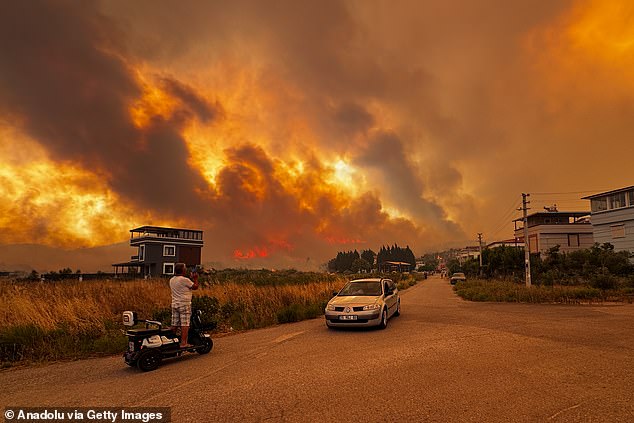
Europe is sweltering under a deadly heat dome, triggering wildfires across Turkey (pictured) and Greece

People sit in the shade near the Acropolis, with 40C expected in Greece on Wednesday

Tourists stand in the shade and hydrate in front of the 5th century BC Parthenon temple in Greece
Europe’s freak back-to-back heat domes killed 2,300 people in eight days, with temperatures reaching 48C.
Portugal alone has recorded 284 deaths during the ongoing heatwave.
In neighbouring Spain, more than 18,000 people in Tarragona were ordered to stay indoors on Tuesday as a wildfire raged out of control.
Last month was the planet’s third-hottest June on record – behind 2024 and 2023 – while Western Europe saw its warmest June since records began, according to the EU’s Copernicus Climate Change Service.
Britain has sweltered in near record-breaking temperatures, with sunseekers across the country heading to the seaside to cool down as it basked in its third heatwave of the year.
New booking data shows that more than half of travellers are now choosing the cooler shoulder season of April, May, and September to explore Europe.
September has even overtaken July as the most popular time to visit hotspots like Italy, Croatia, and Portugal, with off-season demand for Italy up a staggering 166 per cent, while peak-season bookings have plummeted 72 per cent year-on-year.
Mr Mitchell added that the company is shifting away from over-saturated hotspots to quieter, lesser-known places – from Minori on the Amalfi Coast instead of Positano, to Mljet Island in Croatia instead of Hvar.
The effects of rising temperatures and throngs of tourists are beginning to reshape the patterns of European travel, particularly for people from Australia, where long flights and expensive trips require thoughtful planning.