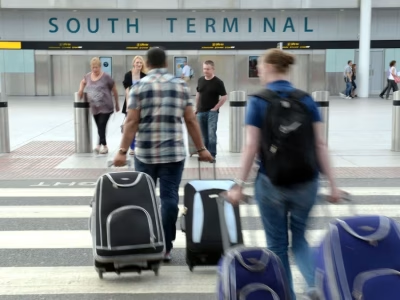
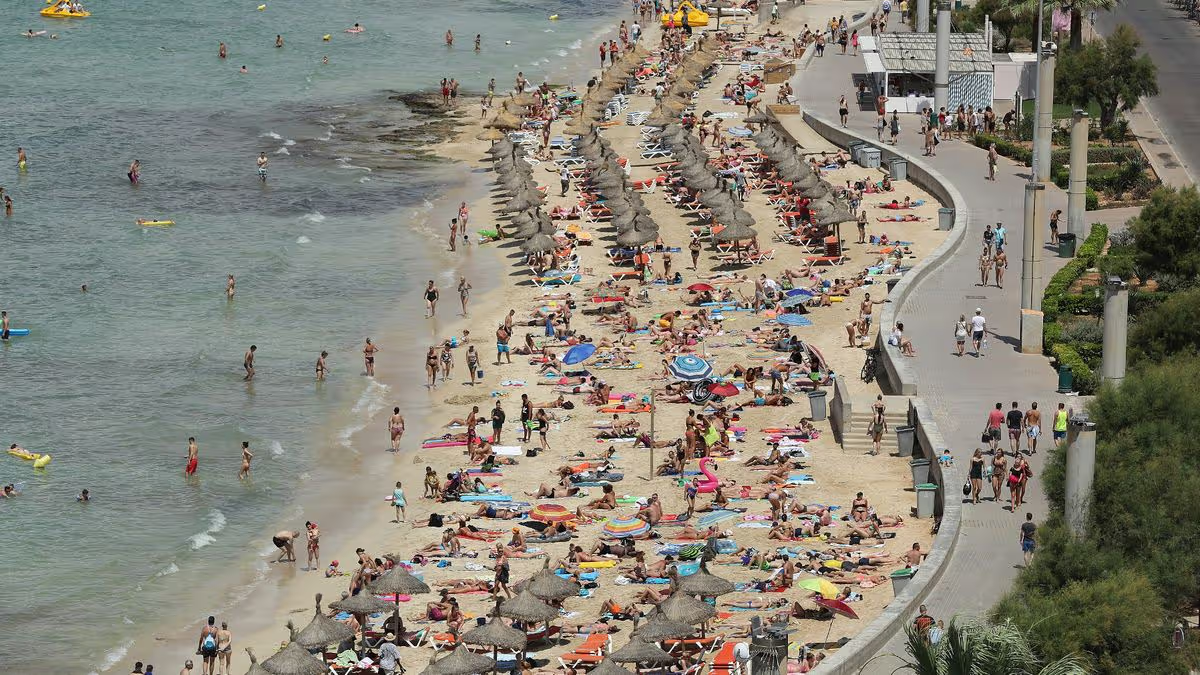
Here’s an outline of all the latest travel news as well as warnings to help holidaymakers who have flights booked this year

A number of warnings have been shared for travellers(Image: Getty Images)
The Middle East crisis and fears of a shortage of jet fuel have triggered uncertainty amongst UK travellers. Many people who have holidays booked this summer are worried about their trips and whether they will still go ahead as planned.
And there have been warnings over the potential of a rise in travel costs. One industry expert cautioned that airlines will not be able to continue “absorbing the cost” of disruption caused by the closure of the Strait of Hormuz in the long term.
Below, we have rounded-up the main travel news as well as general advice for UK holidaymakers to be mindful of ahead of the summer. Latest updates can also be found on ChronicleLive here.
1. Your rights if your flight is cancelled
Travellers are being reminded of their rights and what action they can take if their flight is cancelled. If your flight is cancelled, your airline should get in contact with you to inform you of the next steps.
Those hit by flight cancellations can expect either a refund or rebooking onto an alternative service, while passengers enduring significant delays are entitled to care and assistance, the Department for Transport (DfT) has confirmed. In a briefing document, the department explained that if your flight is cancelled by the airline, you are entitled to a choice between:
- a refund, paid within seven days, and a return flight to the first point of departure at the earliest opportunity (where applicable) or
- to be re-routed under comparable conditions
Passengers whose flights are cancelled, as well as those facing delays of at least two hours on short-haul flights, three hours on medium-haul routes and four hours on long-haul journeys, are entitled to care and assistance. Here’s more information.
2. Martin Lewis warning over hotel bookings and refunds
Holidaymakers were offered some vital advice over hotel bookings and refunds. Martin spoke about the matter on his Martin Lewis Money Show Travel Special on ITV.
A member of the audience asked him about receiving hotel refunds alongside airline refunds if a holiday is cancelled. Martin said: “No, and I think this is what people need to be very aware of. If you booked a package holiday where you booked everything in one under the regulations and rules and protections generally, you would get everything back.
“And so at the moment a package holiday would give you a certain level of extra security that you wouldn’t get if you did a DIY booking. This is when you book your hotel and flight separately.
“If you lose your flight and you DIY booked, there is nothing wrong with your hotel. The issue is you cannot get there, your hotel is still there. It isn’t faulty and it’s not cancelling. You don’t have those consumer rights, you would then say what about using a credit card or debit card protection – it doesn’t work. There’s nothing faulty.” Read more about this topic here.
3. Take out travel insurance straight away
Martin Lewis also says travel insurance must be obtained immediately upon booking a getaway. He said: “The reason you do that is because half of the cover you’re paying for is in case something happens that stops you going before the trip.
“And if you don’t have the travel insurance in place, you’ve got no cover. So, you may as well have it in place. But at this time of year when many people have already booked, I have a slight adaptation, which is this. If you’ve booked and you don’t have it yet, just get it now. Get it done as soon as possible.” Here’s more.
4. Signs of passport damage that could see you turned away at airports
If you’re going on holiday this year, it’s important to make sure your passport is up to standard. People are urged to carry out a number of checks on their document before planning trips abroad.
Firstly, it’s vital that your passport has not expired and has enough time left on it for you to travel to your destination. Some countries, mainly in the EU, require you to have at least three months left on your travel document, while others ask you to have at least six months.
But it’s not just the expiry dates you need to keep an eye out for. You must also ensure your passport is not damaged, otherwise you might not be allowed to travel. So, what exactly counts as “damage”? Here are more details.
5. ‘Hidden fee’ warning for anyone using bank card on holiday
Most people assume that using their normal bank card abroad is fine. But Martin Lewis says a simple switch to a specialist card could save you from paying an extra 2.75% to 3% on every single purchase – a hidden fee that quietly adds to your bill without you even noticing.
The MoneySavingExpert founder explained how most high street banks add a “non-sterling exchange rate fee” when you spend abroad. Ignore it and a £100 purchase effectively costs you £103. Switch to one of the specialist cards he recommends, and you get the same near-perfect exchange rates the banks use – without the markup. Here’s more information.
6. Ryanair alert over cabin bags and extra fee risk
An alert over hand luggage and the potential for extra fees has been issued to Ryanair customers. The airline has explained how passengers could face additional charges at the airport.
The budget carrier, renowned for its no-frills approach to air travel, has been sending emails to customers alerting them to potential extra fees. The messages, sent to those who are planning to solely take the free “personal bag” included with each fare, reads: “If you arrive at the gate with a Cabin Bag that exceeds (40x30x20cm) and don’t have Priority, you will be charged an extra baggage fee.”
The airline clarifies that its standard fare covers only one small personal bag, which must fit beneath the seat in front. Travellers wishing to bring additional luggage have several alternatives available to them. Here’s more.
7. Higher airline ticket prices could be coming
Travellers may have to fork out more money to pay for airline tickets. One air boss has said “it’s inevitable” as the conflict in Iran continues.
According to the director general of the International Air Transport Association, airlines will not be able to continue “absorbing the cost” of disruption caused by the closure of the Strait of Hormuz in the long term. Willie Walsh told the BBC there was no need to panic over potential jet fuel shortages, but warned rising fuel prices would inevitably feed through into higher ticket prices.
He said: “There’s just no way airlines can absorb the additional costs they’re experiencing. There may be some instances where airlines will discount to stimulate some traffic flow… but over time it’s inevitable that the high price of oil will be reflected in higher ticket prices.” Here’s the full story.
8. How to avoid paying airport drop-off fees
Experts have revealed how you can avoid drop-off fees at airports. The vast majority of airports across the UK will levy a charge for dropping someone off at departures, ranging from as little as £3 for a 10-minute stay to as much as £30 for half an hour at Gatwick.
However, there are ways to get around this expense. The team at Money Saving Expert (MSE) have offered some handy guidance on the matter. Here are full details of how you can avoid paying for drop-offs.
Did you know you can make ChronicleLive a preferred source of North East news in Google, which will mean you get more of our breaking news, exclusives, and must-read stories straight away? Here’s more information about what this means and how to do it – you can also do it straight away by clicking here.