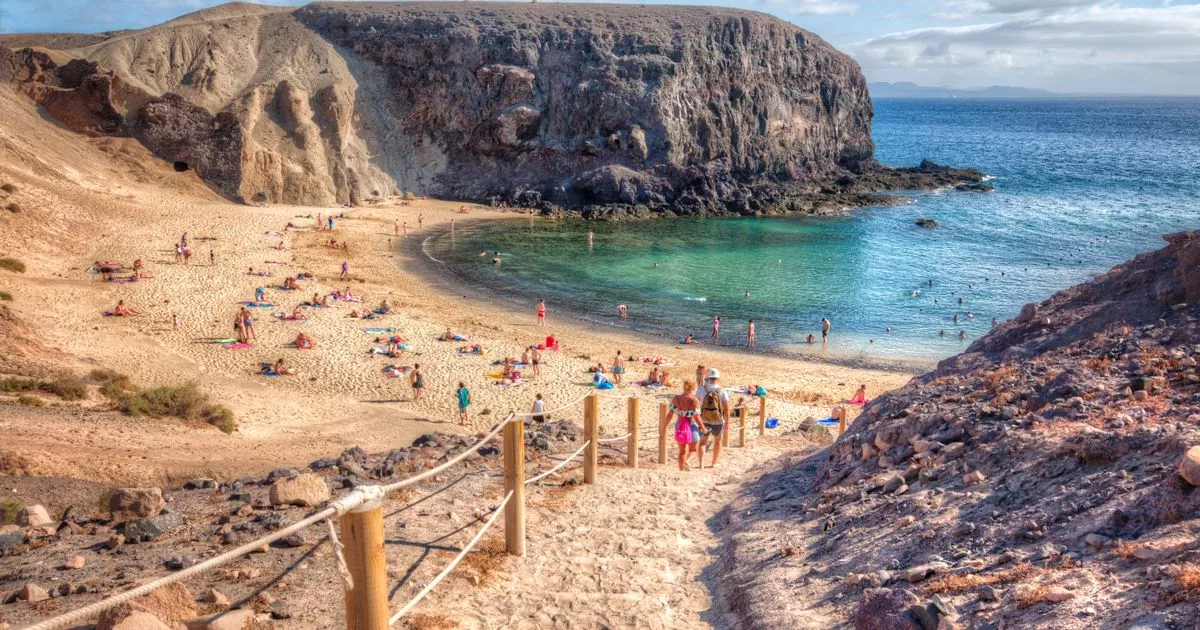
The Spanish island chain of the Canary Islands, which sits off the North West coast of Africa, has been placed on a ‘No’ list, with locals ‘fed up’ and ‘pressure mounting’
The Canary Islands have been placed on an influential ‘don’t travel’ list after years of protests about overtourism.
The Spanish island chain, which sits off the North West coast of Africa, has been placed on Fodors ‘No List’ for 2026. The American publication publishes the list each year. “Fodor’s No List is the rare travel list that encourages both desire and restraint in the same breath. It’s a reality check wrapped in responsible wanderlust. We say it year after year–the No List is not a call for boycott. Its purpose is to highlight destinations where tourism is placing unsustainable pressures on the land and local communities,” the publication explains.
Fodors notes that “pressure is mounting” in the Canaries. In the first half of 2025, the archipelago welcomed 7.8 million visitors and processed more than 27 million airport passengers, a 5% increase over the previous year.
In May, locals fed up with the constant influx of tourists marched in Tenerife, Gran Canaria, and Lanzarote under the banner “Canarias tiene un límite ” (The Canaries have a limit). They argue that the booming tourism market, coupled with soaring housing costs and mounting environmental strain, is threatening the foundations of island life.
It’s a challenging issue to address, as tourism contributes more than a third of the Canary Islands’ GDP and employs roughly 40% of its population.
READ MORE: I found a beautiful UK seaside town packed with independent shops — it’s perfect for winter


John Dale Beckley, founder of the sustainability platform CanaryGreen.org, told Fodors: “Residents have started protesting because they’re genuinely fed up. Traffic is one of the biggest issues. What used to be a 40-minute drive from the north can now take well over an hour each way. The government previously changed regulations that allowed residents to rent out their properties on Airbnb and Booking.com. This has driven up both rental prices and property values. Many young people now find it almost impossible to rent or buy a home.”
Asociación Tinerfeña de Amigos de la Naturaleza, one of Tenerife’s oldest environmental groups, has warned that finding a home on the island is now “virtually impossible” thanks to an “invasion of vacation rentals”. The organisation argues that “no truly local spaces are left” thanks to overcrowding and too many tourists.
In six areas on the Canaries there are more tourist beds than ones for locals. According to Raúl Hernández, there are an average of eight holiday rental spaces per 100 inhabitants across all the islands.
Of all the 200,000 or so holiday apartments there, more than half are owned by people who have just one property – suggesting locals are converting their homes into rentals to make the most of the islands’ status as the most visited tourist area in the EU.
Many people have long been sounding the alarm when it comes to over tourism on the Canary Islands, arguing that the biodiverse, sparse and once remote chain cannot handle the 90 or so million visitors they received in 2019. One of them is Felicitas Brodtrager, a local and academic who has written passionately about the need to change how tourism operates in the region.
“When I set foot out of my home my heart bleeds. My beloved land is in pain. I can see and feel the pain with every step I take in whatever direction. And it hurts. It hurts because it could be different,” he writes of Tenerife. “It could be prosperous, full of hope and marvellously beautiful. It could be thriving, healthy and welcoming. You can’t choose what you call home, your heart decides. Sometimes I wish it would have never chosen this place. It is complicated.”
Aside from housing, one of the major problems in Tenerife – as with the other Canary Islands – is how little is produced there. Just 10% of the largely arid land is cultivated, and that which is is too dry to produce much else beyond potatoes and grapes.
Farmer Natalia Diaz notes that 90% of all food consumed on the island is imported. This is not only a climate issue in terms of transport emissions, but a local waste one. “So, all those hotels and all those tourist hotspots are consuming products from abroad. And the only thing they are leaving us in the Canary Islands is their s**t that ends up in our ocean. Because we haven’t even produced that food here,” she said.
ATAN paints an even starker picture: “The continuous arrival of new residents–mainly Europeans–worsens overpopulation, environmental degradation, and land occupation, given the islands’ very limited space. Essential resources like water are also being pushed to their limits.”
The regional government is now taking action. It has introduced a law stopping newly built properties from being used as short-term rentals, requiring landlords to obtain permits, and allowing neighbors to veto tourist flats in their buildings. National reforms soon followed, giving communities the final say on whether apartments can be used for tourism.