
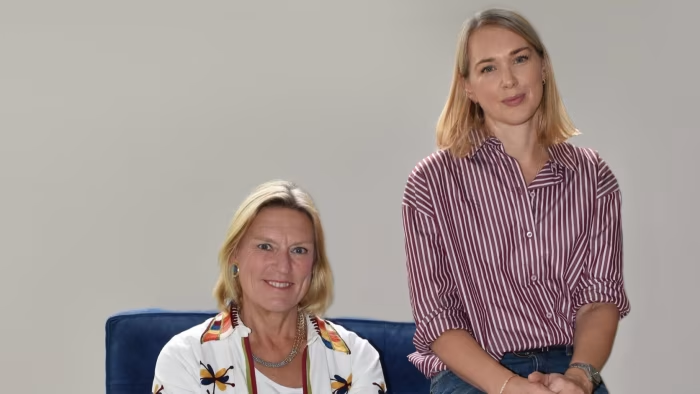
As a jewellery editor and frequent visitor to Sri Lanka, Jessica Diamond often tried to buy one of the island’s famed sapphires to set in a bespoke piece. Yet, even with her industry expertise, she says she never felt confident that what she was being shown was “genuine, good quality, fairly priced or even from Sri Lanka”.
Realising she was unlikely to be the only traveller facing this dilemma sparked a lightbulb moment earlier this year. She reached out to Joanna Hardy, the gemmologist, author and BBC Antiques Roadshow jewellery specialist, with the idea of curating travel experiences in Sri Lanka centred on sourcing a loose gemstone and guiding participants through the process of transforming it into a bespoke jewel once back in the UK.
Just after summer, Hardy & Diamond’s “Gemstone Journeys” was born. A sample six-day itinerary begins at Malabar Hill on Sri Lanka’s south coast and, alongside a talk on gemstone heritage led by Hardy, includes visits to architect Geoffrey Bawa’s estate and an excursion to the Unesco World Heritage Site of Galle Fort. Prices start at £6,950 per person, double occupancy, excluding flights.
The concept taps into the fast-growing market for “experience tourism”, which McKinsey values at around $1tn of the global $9tn tourism industry. More specifically, the consultancy reports demand for luxury travel and hospitality is projected to outpace every other segment, driven by younger, aspirational travellers with a net worth of between $100,000 and $1mn, who are eager to spend on meaningful, high-end experiences.
This particular segment of luxury tourism is expected to reach $391bn by 2028, a 64 per cent increase from $239bn in 2023. Wealthy travellers still enjoy beach escapes, but they are far more likely to seek out what the industry calls “speciality trips”, such as horseback riding along the Silk Road, camel trekking with Bedouin guides, or dog sledging across Greenland. The appetite for cultural immersion and hands-on discovery is reshaping luxury travel.
“No other trip traces a gemstone’s journey from mine to finished jewel while bringing guests along with expert guidance,” says Diamond. “Seeing where a gem is found, then choosing and commissioning your own piece, are usually privileges reserved for insiders — we want to change that.”
Hardy adds that visiting a mine in Sri Lanka, whether for sapphires, tourmalines, topaz, citrine or aquamarine, is, contrary to common belief, both easy and safe. “Sri Lanka has some of the most accessible artisanal mining areas, I even took my 80-year-old mother there,” she says. “That’s how accessible they are.”
But Hardy & Diamond is not the only operator offering such experiences. In 2023, Carlos Torres, a New York-based gemmologist, buyer and consultant, joined forces with Laurent Massi, owner of the Paris-based consultancy Neogem, to launch The Gem Odyssey and organise gemstone expeditions to mining regions across the world. Destinations include Mexico for opals, Colombia for emeralds, Thailand for rubies and Brazil for Paraiba tourmalines.

A five-night itinerary in the Mexican state of Querétaro, priced at $4,900 per person for a group of 10, includes visits to two or three opal mines, where travellers can spend a day working alongside miners drilling, breaking rock and hauling wheelbarrows. The experience also features a curated meal at the mine, hosted by its owner and family, a local opal-cutting workshop, and a visit to an artisanal obsidian studio to learn traditional stone-carving techniques. The programme rounds off with explorations of the surrounding area and restaurants.
“[The] Gem Odyssey is about education and connection, not only with gemstones, but with the people and cultures that make this industry possible,” says Torres. “There’s so much beauty, skill and human effort involved, yet most people never see that side of the story. We saw a gap in the market for immersive, hands-on travel experiences, with each destination highlighting a different stage of the gemstone ecosystem, whether it’s mining, cutting, trading or craftsmanship.”
When it comes to logistics and safety, Torres emphasises that The Gem Odyssey works only with trusted local partners he has known throughout his years as a gemmologist and consultant. “The trip isn’t ‘exclusive’ because of cost,” he says. “It’s exclusive because of the unique access and relationships we’ve built within the industry.” Participants have ranged from industry professionals to private clients, including ultra-high-net-worth travellers seeking an educational, behind-the-scenes experience of the gemstone world.
One such traveller, Erika Rodriguez, a digital marketing professional, says her interest in the Querétaro trip was sparked after hearing Torres describe his visits to the mines. “We wanted to do something different, something few people get to experience and that isn’t offered in many places,” she says. “We just wanted that friends-and-family feeling, going to the mine, meeting the people, eating with them, having conversations.” The experience left her in awe and gave her a new appreciation for jewellery.
“Luxury travel is now two a penny,” says Paul Russell, psychologist and founder of training company Luxury Academy. He notes that such experiences tap into what psychologists call self-expansion, the desire to grow through novel and meaningful challenges. They also meet a deeper need for narrative identity, stories that express who we are, rather than merely what we can afford.
“It’s still about distinction,” Russell adds. “But we’ve moved on from the era of visible consumption, as today’s affluent travellers seek what we might call discreet exceptionality, or experiences that can’t be replicated or commodified. It’s about luxury that feels emotionally resonant, not just financially exclusive.”