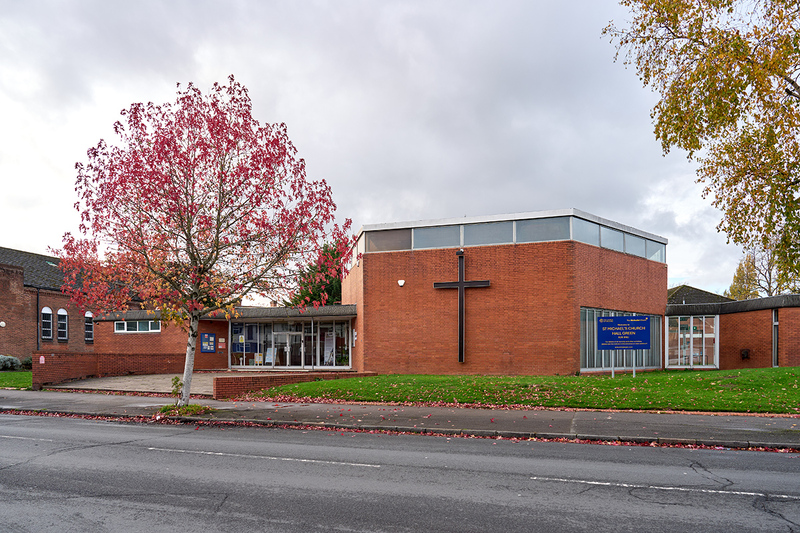
Church Housing Association is eyeing plans to build homes when it redevelops St Michael’s Church in Hall Green, Birmingham
St Michael’s Church in Hall Green, Birmingham, is in poor condition. Tiles are crumbling from the ceiling of the sparse 1971 building. An older wing of the church, built in the 1930s, has been closed for safety.
It’s here the Church of England’s new housing association wants to build some of its first homes.
Inside Housing is visiting the sites that Church Housing Association is hoping to turn into a pipeline of affordable homes. With us is Eddie Hughes, former homelessness minister in the last Conservative government, and just one of the familiar housing sector figures we’ll meet on the tour who are advising on the new housing association in its initial phases.
“Ultimately the intention will be, when all works are complete, to have developed some social housing on the site,” Mr Hughes says. “But also to have left behind us the legacy of a more modern, usable, functional worship and community space.”
He can’t yet say how many homes will be built here, or even if any of the existing church can be retained, but the congregation is open to the idea of a church and community space on the ground floor, with flats – including affordable housing – above.
From bombshell to drawing board
It’s been four years since Inside Housing first reported that the Church of England might start its own housing association, something we described at the time as a “bombshell”. That was 2021, the same year that two archbishops published the Coming Home report, setting out the case “rooted in the Christian story” for the church to be building secular, affordable housing on its land.
Now, that vision is starting to take shape. Church Housing Association registered with the regulator this March. And the first projects are, if not actually being built yet, on the drawing board.
Inside Housing has bundled into a rickety red minibus for the tour, along with a group of sector leaders who have been drawn in to do consulting and interim work to help the new housing association get started.
Among them is the new association’s project director, Aileen Evans. After she stepped down as chief executive of Grand Union Housing Group in October 2024, Ms Evans had planned to take a break, when she was approached by a board member for the new Church Housing Association. “I was going to take five months off – and I lasted five weeks,” says Ms Evans.
Also on board is Sarah Ireland, formerly a senior executive at Accent, and Alan Fraser, former YMCA chief executive.
And there’s Mr Hughes, a civil engineer by training, who was assistant director of the YMCA before being elected to Westminster in 2010. He stood in the 2024 election as the Conservative candidate in Tamworth, not far from Birmingham, but was defeated by Labour’s Sarah Edwards. “When I saw the election result come through,” Mr Fraser starts off saying, right before Mr Hughes jumps in to finish his sentence, with a laugh: “I thought, ‘I’ve got a job for that man.’”
This project at St Michael’s is small – but the potential for building on Church of England land is huge. Between the Church Commissioners and 42 diocese, the church owns roughly 200,000 acres of land. Church Housing Association was set up by Gloucester diocese, and it is working on 40 projects, with a potential pipeline of 1,200 homes.
Is there any kind of proselytising element to this project? Ms Evans says not. “The church just wants to do housing in a Christian way. But not religious housing.” The Church’s aims are to make best use of its assets to bring a benefit to the community, she says.
Next stop on the tour is a scrap of “glebe land” at the back of the parsonage of Bishop Latimer. Glebe land is meant to support the parish priest. “I think it was originally used for the vicar to graze his horse,” says Mr Fraser. “It was community allotments for a bit of time.” Now it’s scrappy vegetation with a layer of rubbish on top.
The church is about to go to planning to build 17 homes here, mostly three and four-bedroom houses, at a cost of about £4.4m. Nine of the homes would be built on the glebe land, and the association is hoping to be able to purchase some neglected land next door, which is the site of an illegal house in multiple occupation (HMO) that has been shut down by the courts.
The quaint parsonage provides offices for the community group Newbigin Community Trust, which runs three community hubs in the area. It provides playgroups for kids with special educational needs, holiday clubs in the park and blacksmithing courses. On Mondays and Thursdays, 80 kids turn up for roller-skating sessions.
“The secret sauce that we hope we can add to the mix here is that we’ve got groups on the ground that we can link with, which hopefully will amplify the impact of the housing,” Mr Fraser says.
Benefits Street
This site backs onto James Turner Street – the location of the controversial Benefits Street documentary that aired in 2014, where 95% of residents did not work. Eleven years later, many of the properties on the street have been turned into HMOs – some illegally.
Official statistics from Birmingham City Council in May put the number of known HMOs here in the Soho and Jewellery Quarter ward at 285, but the figure is likely much higher.
The homes on James Turner Street were originally owned by housing associations, then sold off and bought largely by private landlords. The Daily Mail went to interview residents 10 years after the programme aired and reported that life has “got worse” on the street.
“What I’d really like to do is start buying ‘Benefits Street’ properties… one here, one there, and then we own the lot,” says Ms Evans.
“There’s a promise to that community,” she adds. “If we start buying a couple of houses a year on ‘Benefits Street’, then we can really make that area different.”
More immediately, Newbigin Community Trust is enthusiastic about the idea of homes being built on the glebe land next door, which could bring much-needed affordable – and decent – housing to the area. Chief executive Megan Tucker says that the families that come to Newbigin are often living in overcrowded HMOs. There is poverty, insecurity, and lots of people being housed here temporarily as asylum seekers or after coming out of prison.
“I know a family that was placed on Beaton Road, and when they turned up, mum and two girls, there was still vomit in the bed from the previous occupant. And they were just landed there. But then they got a call about two years later saying, ‘We’re coming to pick you up tomorrow, have everything ready,’” Ms Tucker says. She estimates that “100%” of people who come to the hub have a housing issue of some kind.
“If we start buying a couple of houses a year on Benefits Street, then we can really make that area different”
We go and visit one of the Newbigin hubs, where people of all ages are chatting and doing crafts. Youth worker Dan used to work in the local school. “We had so many children coming in that were tired. Their clothes obviously weren’t clean because there was nowhere to wash them, and they were hungry,” he says. “It’s heartbreaking to be honest. And if we could just have some more housing around here…” he tails off.
But for the new Church Housing Association, it’s not so simple to start building homes that would provide better housing for this community. One problem is finance. Inside Housing has tagged along on this tour, but it was actually organised for Adam Ruffinato, head of structured finance at Charity Bank. He’s one of the financiers the church is talking to about some kind of bridging finance.
“If people like Adam will lend me the money…” says Ms Evans.
Mr Fraser adds: “The issue that the housing association has got at the moment is, although it’s got excellent leadership and the church has got a good covenant, the reality is we haven’t got a whole load of assets we can borrow against.”