
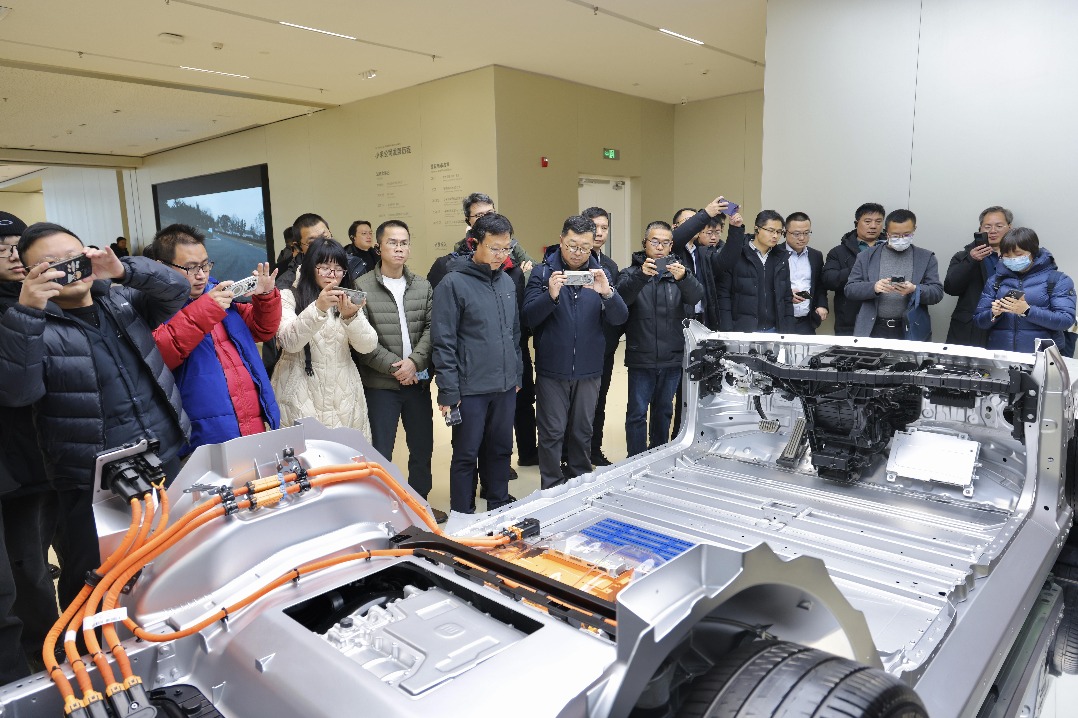
Chinese companies are making factory tours a must-see for modern consumers, giving average people insights into how the world”s major manufacturer ticks.
At the Beijing Economic-Technological Development Area, bookings for visits to electronics manufacturer Xiaomi’s car production line have been on the rise among tech enthusiasts eager to witness the innovation and automation being used to produce the company’s SU7 and YU7 models.
With the goal of integrating professional knowledge with physical displays and delivering a popular science experience to visitors, the factory has had more than 150,000 bookings from April last year to June this year, welcoming a monthly average of over 10,000 visitors, according to Shi Xiaomin, who is in charge of the project.
Factory tours have emerged as a trend in China’s tourism market, as localities nationwide innovate the “industry + tourism” integration model to offer more diverse experiences for visitors.
China has established a comprehensive, independent and integrated modern industrial system and left behind abundant historical and cultural heritage, according to Xin Guobin, vice-minister of industry and information technology.
“In recent years, remarkable achievements have been made nationwide by taking the development of industrial culture as a key driver to promote the creative transformation and innovative development of cultural resources such as industrial heritage,” he said.
Official data shows that China has 264 industrial heritage projects at a national-level and 500 at a provincial-level. Under the industrial tourism trend, a growing number of industrial heritage sites have been transformed into cultural and creative parks, commercial hubs and technology parks, drawing visitors to these destinations.
At the Liuzhou Luosifen Industrial Park located in Liuzhou, Guangxi Zhuang autonomous region, visitors can witness the production of pre-packaged luosifen, or river snail rice noodles, on-site, followed by making a bowl of the noodle soup themselves.
At the Tsingtao Beer Museum in Qingdao, Shandong province, an immersive time-travel drama experience has proved popular among young people. Taking on the role of Tsingtao Beer brewers, visitors step into a live-action role play that integrates scripted murder mystery and escape room challenges.
Industry observers believe the innovative model integrating visits, research and study, and consumption caters to the interests of varied guests, who can get up close to industrial scenes that are usually hard to access. It also delivers brand value and revenue growth to relevant enterprises, they said.
The market potential of the country’s industrial tourism sector is expected to maintain an average annual growth rate of 18 percent over the next five years, with the market size expected to exceed 300 billion yuan ($42.4 billion) by 2029, according to the ministry.
China has outlined plans to accelerate the development of a strong manufacturing sector and to promote the deeper integration of culture and tourism in recommendations for the 15th Five-Year Plan (2026-30) for economic and social development.
The ministry said it will promote the protection and inheritance of industrial culture, explore effective mechanisms for the integrated development of culture, technology and industry, as well as create a number of new cultural consumption scenarios and cultural industry clusters.
Xinhua