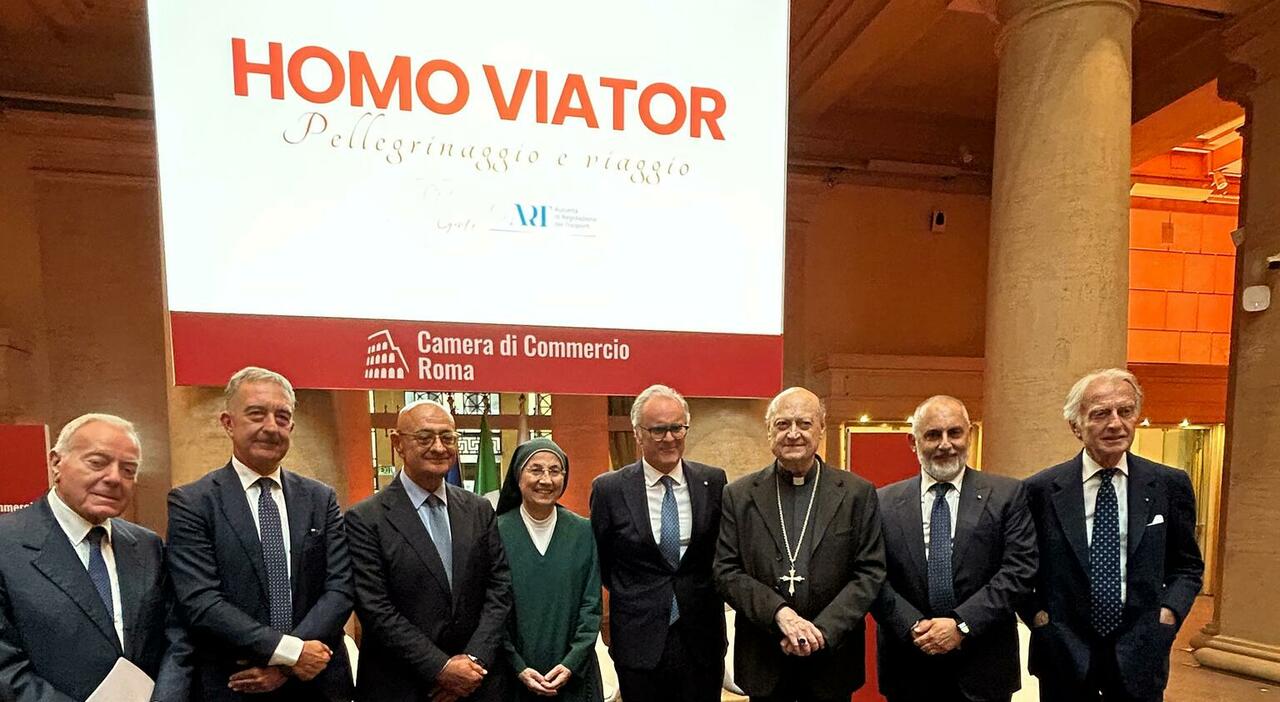
Yesterday in Rome, in the evocative setting of the Temple of Vibia Sabina and Hadrian, the seat of the Rome Chamber of Commerce, the dialogue “Homo Viator. Pilgrimage and Travel” took place, organized by the “Courtyard of the Gentiles,” the Foundation established by Cardinal Gianfranco Ravasi to promote dialogue between believers and non-believers, and the Transport Regulation Authority. The initiative was born with the aim of deepening the spiritual and cultural meaning of pilgrimage, also in connection with the Jubilee, and to concretely reflect on mobility and its economic and social impacts and implications.
The meeting, opened by the speeches of His Eminence Cardinal Gianfranco Ravasi, President Emeritus of the Pontifical Council for Culture and founder of the “Courtyard of the Gentiles,” and Nicola Zaccheo, President of the Transport Regulation Authority, saw the participation of numerous distinguished guests including Gianni Letta, Stefano Donnarumma, CEO of Ferrovie dello Stato, Luca Cordero di Montezemolo, President of Italo Treno, Sr. Rebecca Nazzaro, Director of the Opera Romana Pellegrinaggi, Vincenzo Nunziata, President of Aeroporti di Roma, and Antonino Turicchi, President of Autostrade per l’Italia.
The dialogue was an opportunity for the leaders of major transport companies and pilgrimage organizations to discuss travel, understood as a cultural, economic, and social phenomenon, in an increasingly interconnected and mobile world, and pilgrimage, a spiritual and transformative experience. Among the topics at the center of the debate: the impact of tourism, the economic opportunities linked to mobility, the challenges of sustainability, and the role of travel and pilgrimages in building identity and inclusion.
Stefano Donnarumma, in his speech, focused on the cultural and emotional value of travel, particularly by train, as an experience of reunion, discovery, and hope. Vincenzo Nunziata then emphasized the importance of integration between means of transport to offer services increasingly in line with the needs of passengers, focusing on the travel experience of the person. Luca Cordero di Montezemolo spoke of the parallel between travel as a human experience and the journey of life, in which freedom, curiosity, and the spirit of adventure are fundamental. Sr. Rebecca Nazzaro highlighted that pilgrimage, like life, should always have the destination at its center and that the journey, particularly towards Rome, the “holy city,” is laden with special meaning for all pilgrims, especially during the Jubilee. Antonino Turicchi, speaking about highways, pointed out that they are not just great engineering works, but visions that have transformed into great enterprises at the service of people, travelers, and pilgrims.
“Travel, in its deepest dimension, is an experience of transformation, search, and encounter,” commented Cardinal Ravasi. “Man moves and travels for ever new and different reasons that change and evolve over the course of history. Pilgrimage, on the other hand, combining the spiritual aspect with the concreteness of the human journey, is able to intertwine faith, culture, and social commitment in a timeless dimension. In an era marked by continuous mobility and increasing interconnection, it is essential to reflect on the sense of moving, not only as physical displacement but as openness to others. For this reason, meetings like yesterday’s, with the participation of prominent figures from the world of transport companies and pilgrimage organizations, are important and significant: a concrete example of dialogue between believers and non-believers, between Catholic and secular institutions, today more necessary than ever to face the great ethical, economic, social, and cultural challenges of our time. A tangible proof also of the “Courtyard of the Gentiles” commitment to its mission.”
“I thank His Eminence Cardinal Ravasi and all those present for sharing this extraordinary moment,” commented Nicola Zaccheo, President of the Transport Regulation Authority. “A precious opportunity to question ourselves on the profound meaning of travel, which from a constitutional right elevates to an ancestral need of man. The interventions of all the speakers, of an excellent level, invited a deep reflection on travel in all its forms, between movement and spirituality. For us at ART, it was also an opportunity to measure ourselves with a different point of view compared to the activity of the regulator. The hope, which I shared with the distinguished guests, is that those who, like us, habitually work with rules, tariffs, and infrastructures, never lose sight of their duty, which is also a privilege, to promote the most important exploration: the journey to become ever more aware human beings.”
The “Courtyard of the Gentiles” is the Foundation established by Cardinal Gianfranco Ravasi (and chaired by Professor Giuliano Amato) to promote dialogue between believers and non-believers. Working in close connection with the Vatican Dicastery for Culture and Education, since 2011 the “Courtyard of the Gentiles” has established itself as an open space for the pluralism of ideas and a privileged place for meeting and discussion on the great ethical and cultural issues of our time. Every year, the Foundation addresses and deepens numerous current themes (and problems) such as ethics, legality, science, faith, culture, youth, and new technologies through events, meetings, debates, research, and sharing opportunities, involving prominent personalities, both secular and Catholic, from the world of culture, institutions, and businesses.
The Transport Regulation Authority (ART) was established pursuant to Article 37 of Decree-Law 6 December 2011, no. 201 (converted into law, with modifications, by Law 22 December 2011, no. 214) within the framework of the regulation of public utility services pursuant to Law 14 November 1995, no. 481. It is competent in the transport sector and access to related infrastructures. Among its tasks is also the definition of the minimum quality conditions of transport services and the minimum content of the rights of users towards service and infrastructure managers. The Authority operates in full autonomy and with independence of judgment and evaluation, in compliance, where present, with European regulations and in any case in compliance with the principle of subsidiarity and the competences of regions and local authorities.
© ALL RIGHTS RESERVED
This article is automatically translated