
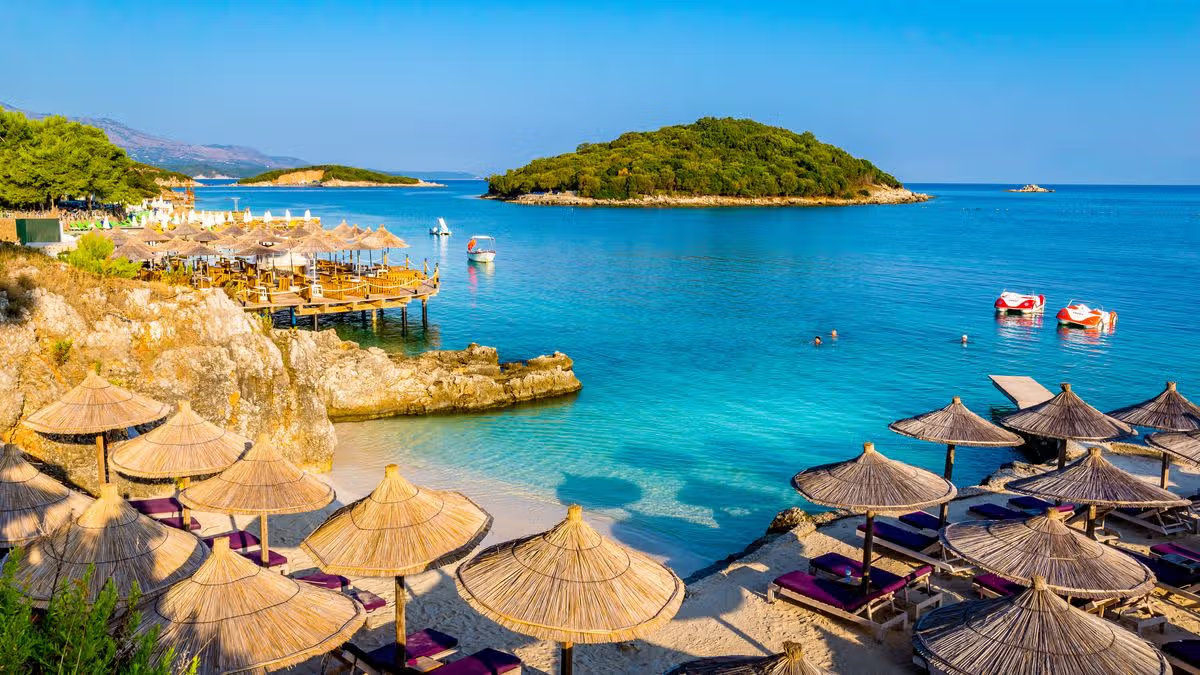
If you’d rather spend less time waiting at border control and more time enjoying your holiday, you could try somewhere a little different

Go somewhere new this summer(Image: Marius Roman / Getty Images)
You’ve probably seen the headlines claiming British travellers could face queues of up to six hours this summer because of Europe’s new Entry Exit System (EES).
The new system replaces passport stamps for non-EU travellers with digital biometric checks, meaning British passport holders will need to provide fingerprints and a photo when entering the Schengen Area for the first time.
It’s now being introduced at airports across popular holiday destinations including Spain, Portugal and Greece, with some reports warning that border checks could take between two and three hours during busy periods.
With the summer holidays in full swing, it’s no surprise many people are looking for ways to avoid long queues and overcrowded tourist hotspots. So if you’d rather spend less time waiting at border control and more time enjoying your holiday, why not try somewhere a little different?
I’ve rounded up some of my favourite destinations where you can skip the new EES checks and still enjoy an incredible summer getaway.
And don’t forget to follow me on TikTok for more travel advice, destination guides and holiday inspiration.
Albania
Albania is ranked among Europe’s most affordable travel destinations and has a mix of buzzing cities and seaside resorts that cost far less than EU hotspots like Greece.
For a sun-soaked escape, Vlorë in Albania offers the same Mediterranean climate, clear Ionian waters, and historic charm as its Greek coastal counterparts.
Situated on the Albanian Riviera, Vlorë is a rising destination teeming with fresh seafood, seafront bars, and boutique stays at a fraction of the cost.
Spend the day on the quiet shores of Narta or Zvernec Beach, or take a boat to the Karaburun Peninsula for secluded coves that rival Greece’s best beaches.
In the evening, explore Vlorë’s historical centre, where Ottoman architecture meets a growing food and nightlife scene.
Kotor, Montenegro
As more travellers look to avoid overcrowded destinations, soaring prices, and long queues at EU airports, interest is shifting towards lesser-known, better-value spots in Eastern Europe in 2026.
One of this year’s biggest travel trends is the rise of ‘destination dupes’ – places that offer a similar vibe to popular holiday hotspots but without the hefty price tag or the crowds.
One of the best dupes I’ve come across is swapping busy Dubrovnik in Croatia for the coastal town of Kotor in Montenegro.
It boasts the same jaw-dropping scenery, a charming old town, and stunning views of the Adriatic but feels far more relaxed and significantly less touristy.
This Unesco-listed town is a maze of cobbled streets, Venetian-era palaces, and café-lined squares. Its historic fortress walls and waterfront setting evoke a cinematic feel – much like Dubrovnik, but without the cruise-ship crowds.
Beyond the old town, the bay’s fjord-like landscape is perfect for boat trips and kayaking. You may also like to explore nearby Perast, a postcard-perfect village filled with churches and palaces.
Essaouira, Morocco
Sunny breaks can end up costing a fortune if you’re hitting Europe’s holiday hotspots in peak season. Especially if you miss your flight due to EES queues.
However, there’s a wallet-friendly destination with more than 300 days of sunshine, cheaper spas and hotels, and flights from £29: Essaouira in Morocco.
Often overlooked by the typical tourist crowd, this windswept seaside town on Morocco’s Atlantic coast is a brilliant budget wellness spot with spa and wellness centres, steamy hammam sessions, and surfing schools.
The low-cost coastal city is famous for its Unesco World Heritage Site medina, chilled vibes, ramparts, historic port, and colourful markets where neighbourhood cats roam freely.
No visit to Essaouira would be complete without exploring the Skala de la Ville, the ancient defensive walls that once protected the town from pirates and invaders.
Stretching along the oceanfront, these fortified ramparts are home to bronze cannons that have stood the test of time since the 18th century.
Not only are they a slice of Essaouira’s military history, but they also offer epic views over the crashing Atlantic waves.
Along with history and markets, Essaouira is a top spot in Morocco for a surf lesson in the bracing Atlantic Ocean. From sweeping Essaouira Bay to Sidi Kaouki and Moulay Bouzerktoun, the waves are surfable all year round on this windswept stretch of coast, though they are more powerful in the winter months.
Khiva, Uzbekistan
For adventurous travellers who want to experience a new culture, Uzbekistan is a Central Asian nation and former Soviet republic that’s worth a visit.
The country is known for its opulent mosques, mausoleums and other sites linked to the Silk Road, a network of trade routes that stretched from Asia to the Mediterranean Sea.
As one of the ancient cities along the Silk Roads, Khiva was an important post connecting two powerful lands, China and Rome, and it was a centre of education, science, and culture.
Visiting today, you might be forgiven for thinking Khiva’s old town was a film set. The glittering turquoise tilework, sand-coloured city walls, lines of camels and towering minarets give the impression you have accidentally wandered into a historical drama.
Wander through narrow streets lined with domed structures and minarets, and you’re walking in the footsteps of merchants, explorers, and scholars who crossed these same paths centuries ago.
The smell of spices, the vibrant colours of woven fabrics, and the sight of immaculately restored madrasahs transport you back to when Khiva was a vital link between China and Europe.
These marketplaces, filled with traders selling intricate ceramics, silk scarves, and carved wooden treasures, haven’t changed much in appearance or atmosphere over the centuries.
The Ichon-Qala, or inner city, is where Khiva’s architectural heritage truly comes to life. This UNESCO-listed old town is a maze of mud-brick walls and vividly tiled facades, carefully preserved to keep the city’s historic soul intact.
Walking past the Kalta Minor Minaret, its dazzling blue-green tiles catch the sunlight, evoking the wealth and significance of the city’s heyday.
Khiva continues its long tradition of trading with beautifully presented market stalls dotted around the old town. The neat stalls and inviting traders make Shopping in Khiva a real pleasure.
The stalls overflow with bright fabrics, ceramics, figurines, traditional clothing, and even fur hats, which causes a wry smile when considering the 98°F conditions.
Sarajevo, Bosnia-Herzegovina
Bosnia-Herzegovina’s fascinating and hugely underrated capital, Sarajevo, boasts a distinct east-meets-west vibe with a rich and complex history, stunning Austro-Hungarian architecture, and intriguing museums.
In the 1990s, Sarajevo endured the longest siege of a capital city in modern history during the Bosnian War.
The siege resulted in significant loss of life and infrastructure damage. Post-war reconstruction has slowly been transforming Sarajevo into a modern city with a growing tourism sector.
Begin your visit with a trip to Baščaršija, Sarajevo’s old bazaar and cultural heart. Here, narrow cobblestone streets are lined with small shops selling traditional crafts, jewellery, and delicious local delicacies. Don’t miss trying the famous cevapi – grilled minced meat sausages served with bread.
No visit to Sarajevo would be complete without a visit to the Sarajevo Tunnel Museum. This poignant site offers insights into the city’s recent past during the Bosnian War, providing a deeper understanding of its people’s resilience and the complex history that shaped them.
Jordan
The UK Foreign, Commonwealth, and Development Office (FCDO) no longer advises against travel to Jordan, so now might be the time to explore this incredible destination.
One of the must-see sites is Petra, an ancient city and archaeological site in southern Jordan.
Petra is believed to be more than 2,300 years old, though the exact date of its construction is unknown. By the first century BC, it was the capital of the Nabataean Empire, which grew rich from trading frankincense, myrrh, and spices.
Today Petra is an archaeological park covering 264,000 square metres in Wadi Musa. It has a visitor centre and several Bedouin shops selling coffee, snacks, and souvenirs.
An entrance ticket costs 50 JOD (about £51). The visit starts in the Siq, a narrow gorge cutting through rose-red rock. The walls rise high above, sometimes just a few metres apart, streaked with pink, russet, and gold where wind and floods have smoothed the stone.
It feels cool and echoey in places. If you visit with a guide, they’ll probably show you ancient water channels carved into the rock, proving the Nabataeans were skilled engineers as well as architects.
Then the Siq opens up just enough to frame Al Khazneh, the Treasury. Carved into the sandstone cliff in the first century AD, its façade rises to about 40m, with Corinthian columns, ornate capitals, and dramatic details.
Wander around, and you’ll see a theatre that may date to the early first century AD, the Petra Church Complex, the Pharaoh’s Column, and Qasr Bint Far’un (Palace of the Pharaoh’s Daughter).
As you walk past the Treasury, you’ll start to spot a few cafes and shops run by Bedouins where you can try Arabic eyeliner, buy souvenirs, and try pomegranate juice.
Armenia
If you’re an adventurous traveller looking to visit new destinations not flooded with mass tourism, Armenia deserves a spot on your bucketlist.
Few places capture the complex sweep of human history like Armenia. This small, mountainous nation has witnessed empires rise and fall and endured profound tragedies, all while preserving a resilient culture that remains defiantly unique.
Its long story is etched into its dramatic landscapes, seen in medieval monasteries, hilltop churches and the ancient streets of Yerevan, a city that predates Rome by centuries.
Exploring Armenia means embracing the unexpected: ancient monasteries carved into cliff faces, culinary heritage, and one of the world’s oldest wineries.
The capital, Yerevan, may be ancient, but it thrives with a dynamic, evolving character that continually adds swish new restaurants, bars, and cultural spaces.
Urartian King Argishti I founded the city in 782 BC as Erebuni, making it one of the world’s oldest continuously inhabited cities.
Yet Yerevan refuses to be trapped in the past. Today, this trendy capital has earned its nickname as Armenia’s ‘Pink City’ thanks to the rose-coloured tufa stone that gives its buildings a distinctive hue.
Begin your exploration at Republic Square, the social and architectural heart of Yerevan, where locals gather and musicians perform.
From there, make your way to the Cascade Complex, a multi-tiered stairway that doubles as an open-air museum for contemporary art, offering panoramic views of Yerevan with the majestic Mount Ararat in the distance.
Dalaman, Turkey
Along Turkey’s scenic southwest coast, Dalaman has a shimmering blue lagoon and one of the country’s most beautiful beaches. It’s also a surprisingly affordable destination for a slice of sun-soaked paradise if you can bag a good deal.
One of the most popular spots here is Oludeniz’s Blue Lagoon, located within the protected national park officially known as the Oludeniz Tabiat Parki.
This dreamy spot is well-known for its untouched natural beauty, and stepping into the lagoon means you’re entering a preserved slice of Turkey’s Mediterranean coastline.
The park encompasses the renowned Blue Lagoon, ensuring that the waters and surrounding environment remain clean and unspoiled, while regulating development to preserve the area’s natural state.
A modest entrance fee grants access to the national park, which encompasses Belcekiz Beach and the lagoon area. The amenities are well-kept, featuring toilets, showers, and ample shaded spots to take refuge from the scorching midday sun.
The park also provides rental services for sunbeds and parasols, and there are kayaks, pedalos and paddleboards available for hire if you wish to explore the serene lagoon waters.
Azerbaijan
Azerbaijan is a transcontinental, oil-rich nation bridging Eastern Europe and Western Asia, famously known as the “Land of Fire” due to its abundant natural gas and oil reserves.
Step into Baku, Azerbaijan’s capital, where ancient architecture blends with sleek, modern lines. Skyscrapers stand beside centuries-old city walls, mixing Persian influences with European elegance.
Stroll the cobbled streets of Icherisheher, Baku’s medieval Old City, with its caravanserais, mosques, and 12th-century Maiden Tower, where you’ll discover layers of history dating back to the Palaeolithic Age.
In contrast, Baku’s Flame Towers and modern skyline, which rise in sleek, angular designs, are reminders of the city’s rapid modernisation.
Azerbaijan’s cuisine, which capitalises on its bountiful fresh produce, including grains, fruits, meat, and figs, is also worth trying.
Dishes are vibrant and packed with spices, typically served in copper and clay bowls, while flavours range from the tang of pomegranate to the smokiness of grilled meats to the richness of stews.
Across the country, you can dine on the national dish of plov (pilaf), lavangi (stuffed chicken or fish with walnuts), and baklava, which are all served with the traditional çay or Azerbaijani tea.