
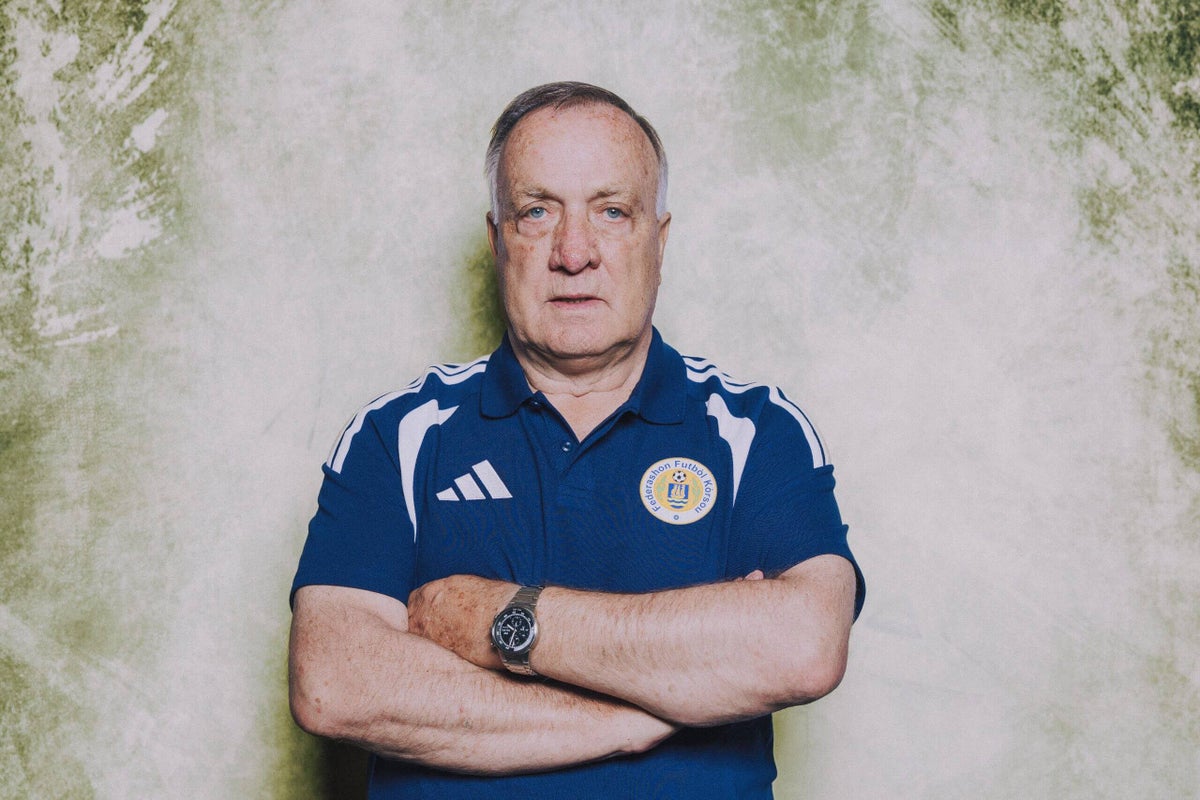
Dick Advocaat was not supposed to be at the World Cup. He had something more important to do.
After pulling off the near-miracle of guiding Curacao to qualification — the tiny Caribbean island nation with a population of just over 150,000 are the smallest country ever to reach the tournament — Advocaat stepped down.
His daughter was ill: Advocaat actually missed the game that sealed their place in North America, a draw with Jamaica in November, and in February he resigned to help care for her. “I have always said that family comes before football,” he said at the time. “This is therefore a natural decision.”
This was lined up to be, potentially, the swansong of a long and glorious career which dates back to 1980, and has taken in three spells in charge of his native Netherlands national team.
He was replaced by Fred Rutten, a veteran Dutch coach who has taken charge of Feyenoord and Schalke among others, and it seemed he would take Curacao to the United States, Canada and Mexico, rather than Advocaat.
But then everything changed. Advocaat’s daughter’s condition had improved. In early March, his assistant Cor Pot told a Dutch TV show that chemotherapy appeared to be working.
And then in May came the shock announcement that Advocaat was back, replacing Rutten and would actually lead the team into the tournament.

Dick Advocaat speaks to the media after arriving at the World Cup (Megan Briggs/Getty Images)
Advocaat could have ignored the call when it came, but the emotional pull of finishing the job he started was too much. “I’m Dutch,” he said before their first game of the tournament against Germany. “But working for them for two years makes you become a true Curacao national.”
Advocaat did not just muscle in and take his job back from Rutten, despite false rumours of an agreement that would allow exactly that. When Advocaat initially stepped aside, the handover appeared to go pretty smoothly: he recommended Rutten as his replacement, the two men met to discuss the squad, the new coach said he was not going to change much, and the players seemed receptive.
But his brief time in charge did not go well, partly because of bad results — 2-0 and 5-1 defeats by China and Australia — in his two games but more because the squad did not take to his methods. Reports suggested they urged the federation to make a change, and although its president, Gilbert Martina, played down those reports and initially backed Rutten, pressure grew.
Specifically from Atilay Uslu, the CEO of travel company Corendon, one of the national team’s sponsors. You might think a sponsor’s opinion should not be important for something as big as who the coach is, but this one carries more weight than most, because the company’s support has been seen as a key part of Curacao’s success.
After they became a national team in their own right in 2011, following the dissolution of the Netherlands Antilles, Curacao found it difficult to progress because they simply did not have the money to travel to games or pay for the sort of facilities and conditions that other national teams could. Among other things, Corendon provided travel and high-end accommodation, stepping in after an appeal from Martina. Along with the appointment of Advocaat and a dip into the diaspora to recruit players, the sense of professionalism that came with this funding was a contributing factor to them qualifying for their first ever World Cup.
Uslu told the newspaper Extra that his company’s support, worth around €1million ($1.15m, £860,000) a year, would stop after the World Cup if Rutten was kept on. It was not long before Rutten was gone.
Officially, he stepped down, saying: “There must not be a climate that harms healthy professional relationships within the team or staff. That is why stepping down is the right decision. Time is pressing and Curacao must move forward. I regret how things unfolded, but I wish everyone the best.”
A nation turned its lonely eyes to Advocaat. “I was asked if I would be available if Fred Rutten were to step down,” he told the media before his first training camp back in charge, at the end of May. “I was. When he left, things moved quickly. That is how things go in football. It certainly could have happened differently.”
This was on May 12, a month before the tournament started. In any other situation, this would be terrible preparation for a team reaching their first ever World Cup. But because it’s Advocaat, now a national hero on the island, they’re daring to dream.
Advocaat seems delighted to be back. He did not even respond to a particularly mean-spirited pundit, Johan Derksen, who suggested his daughter’s illness was “just an excuse” for his initial resignation. “He says what he thinks. Everyone knows that. But I didn’t agree with these statements.”
At 78, Advocaat is the oldest man to manage at the World Cup, taking a record that lasted a whopping three days: Hugo Broos, the South Africa head coach, briefly held that title after being in charge of their game against Mexico.
Julian Nagelsmann, in the opposite dugout for Curacao’s opening game against Germany, is the youngest head coach at the tournament, 40 years his junior. “No,” was his short answer, after being asked if he’ll still be coaching aged 78. “I love my job, but I hope I have some different things to do at that age.”
“He got a lot of money when he was fired young,” joked Advocaat shortly afterwards, referring to Nagelsmann’s payoff after leaving Bayern Munich in 2023. “I keep going because I like it.”
And so, an unlikely second chapter of an unlikely story begins. “We know it will be very difficult,” Advocaat told Reuters. “But nothing is impossible.”