A new train service has created the world’s longest train journey, allowing passengers to travel across 13 countries

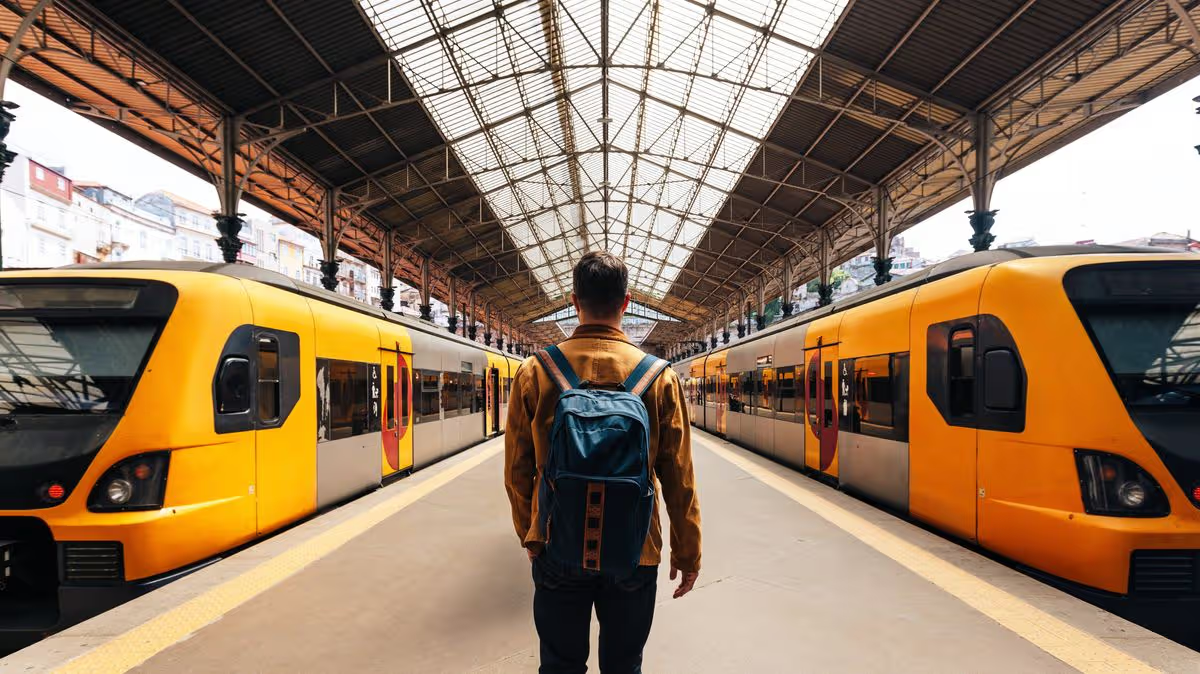
Travellers will be able to travel across multiple borders as part of a new connecting service(Image: Alexander Spatari via Getty Images)
The launch of a brand-new rail service has created the world’s longest train journey, spanning 21 days and passing through 13 countries.
A new rail link between Laos and China now allows travel from Portugal to Singapore entirely by rail.
The epic route covers a staggering 11,600 miles and is operated by multiple railway companies throughout.
Travellers can cross numerous borders while making several spectacular stops along the way.
The mammoth trip offers passengers stunning countryside scenery between the major destinations along the route.
Departing from Lagos in Portugal, the journey concludes in Singapore, reports the Express.
It’s a truly one-of-a-kind adventure, crossing from the western to the eastern hemisphere entirely by train.
From Lagos, the service heads to the Portuguese capital, Lisbon, before stopping at the next stop in the Basque region of Spain.
The train then winds its way through France, Russia, China, Vietnam, and Thailand before finally rolling into Singapore.
Along the way, the service stops at some of the world’s most iconic cities, including Paris, Moscow, Beijing, and Bangkok.
The lengthiest leg of the trip is a gruelling 40-hour stretch from Paris to Moscow.
Despite this marathon section, the journey features 11 stops, giving passengers plenty of opportunities to stretch their legs.
Travellers can also enjoy overnight stays at destinations en route, stepping off the train to explore.
To complete the full journey, passengers must obtain seven separate visas. The overall fare is approximately £1,006, comparable to the cost of a flight from Portugal to Singapore.
Nevertheless, the trip requires considerably more planning than a flight and involves numerous additional stops.
In some areas, passengers must make bus connections to continue their train journey.
These included the stretch from Vietnam to Cambodia, and from Malaysia to Singapore.
The longest journey has only been made possible by the introduction of the Laos-China railway.
It is expected to boost Laos’ economy by allowing it to transport people from China.
The previous longest train journey ran from London to Singapore.