
He urged people to check online guidance as well

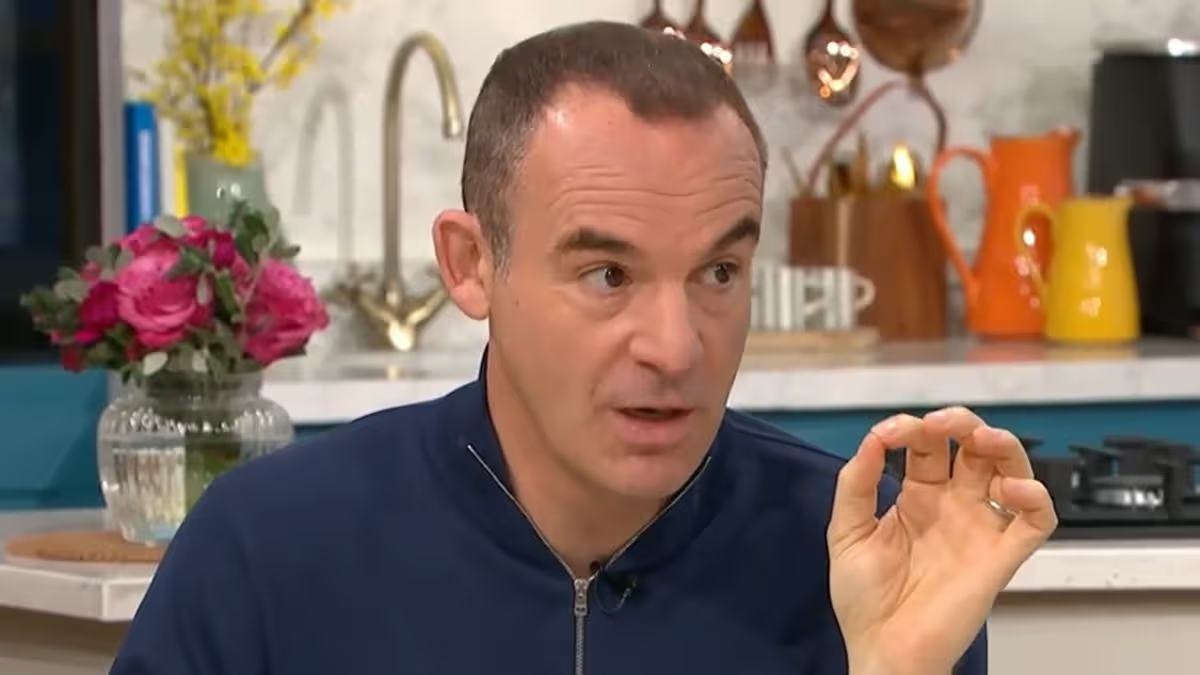
Martin Lewis issued a warning for people going away on holiday(Image: ITV)
Martin Lewis has issued crucial guidance for families planning holidays in the near future. On his BBC podcast, he offered valuable tips in light of the Iran conflict and its potential impact on travel plans. He said you may want to check over your travel documents now ahead of your trip.
His advice came in response to a listener’s query about some travel insurance they had purchased for a July trip to Jordan, booked back in January. The holidaymaker was worried the Iran situation might mean their trip has to be cancelled.
They wondered whether they could reclaim their insurance costs. In light of the question, Mr Lewis provided some more general guidance for anyone whose travel plans might be disrupted by the Middle East conflict. He cautioned: “The golden rule is do not cancel this voluntarily yourself.
“If you do, you lose all your rights. It just becomes that you have chosen not to go, and if you choose not to go, then you are not entitled to a refund and your travel insurance won’t cover you.” In contrast, he said that if your travel provider cancels the trip, you will likely receive a full refund.
However, if your holiday isn’t cancelled but you don’t feel safe travelling, there is an important resource to consult.
Checking the Government website
Mr Lewis urged: “You need to look at the Foreign Office’s travel advice. There can be two different levels of advice that they are giving. The strongest one is no travel, if they are advising you against any travel in that country. The second strongest is against no essential travel.
“Different travel insurance policies have different attitudes. Some will only cover you for no travel, some will cover you for no essential travel as well. Some will say you don’t get any coverage for wars, and they exclude you from any cover off that back of that. It is simply a case of what your travel insurance policy says.”
You can visit the Foreign travel advice section on the Government’s website for the latest guidance for your destination. For instance, at the time of publication, the advice for the United Arab Emirates reads: “Foreign, Commonwealth and Development Office (FCDO) advises against all but essential travel.”
The guidance page also carries this caution: “Your travel insurance could be invalidated if you travel against advice from the FCDO.”
Take action now
Mr Lewis offered another piece of advice for those heading abroad in the near future. He explained: “Anybody who has a trip booked to one of those areas, I would be getting your travel insurance policy now.
“Get the document. My tip would be, take it, it’s usually a PDF, put it into a Chat GPT or Google Gemini or Anthropic Claude, put the document in there, and then ask it questions about what you are entitled to, because these documents are long and turgid.”
He suggested asking whichever AI tool you use to direct you to the specific clause in the policy it’s referencing, so you can verify the details yourself and ensure the information it gives you is correct. The consumer expert highlighted another crucial aspect of your policy worth reading up on.
He explained: “Another thing people should be checking is what is the level of cancellation cover on your travel insurance policy. In other words, if the holiday is cancelled and you had ancillary costs, how much would they cover you up to.”