One evening in June 1990, when I was at university, my friend Bryn walked into the bar. “If you had World Cup tickets,” he asked, “would you go?”
I said, “If I had World Cup tickets, I’d also get some for my friends.”
Bryn said, “That’s not a problem. I can get as many tickets as we want.”
It was all thanks to Mars. The food company was sponsoring the tournament and had lots of match tickets for business associates, but few of them wanted to go. The American and Asian ones mostly didn’t care about football, while Europeans were worried about English hooligans sacking Italy. And so somebody at Mars — the dad of a friend of Bryn’s — had stacks of leftover tickets.
A few days later, three of us were chugging to Dover in Bryn’s battered car. We crossed the Channel by ferry, spent 24 hours in an increasingly smelly railway carriage, and talked our way past two customs officials at a tiny border post in the mountains who weren’t keen to let a suspected English hooligan firm into Italy.
Our friend’s father bought us dinner in a real restaurant in Milan, not a kebab van, then left on a business trip. We stayed in his flat, and never saw him again. We had free tickets for Colombia-United Arab Emirates in Bologna, Czechoslovakia-USA in Florence, and Scotland’s hilarious defeat to Costa Rica in Genoa.

I’ve been to every World Cup since — the eight subsequent ones as a journalist. On December 5 I’ll watch the draw for next year’s, in the US, Canada and Mexico, hoping I’ll get there, and already planning my ideal route: maybe Monterrey, Kansas City, Vancouver. Forget the football — a World Cup is the perfect travel opportunity. You go with a mission, you visit new cities, and you experience them during their biggest party, with thousands of fellow fans as ready-made companions. Some of my best trips have been World Cups.
In 1994, the first time the US hosted, I happened to be living in Boston. I wrote my first articles for the FT during that tournament. I had also wangled a job at ABC TV, the World Cup’s host broadcaster, as a “spotter”. For games in Boston, I’d sit in the commentary box behind the commentators, and whenever a player did anything noteworthy, I had to identify him instantly, so that the producers could put his name on screen.
Unfortunately, my facial recognition skills are terrible. ABC ditched me after the first round.
It hardly mattered: I’d already learnt that the best moments at World Cups are far from the stadium. In one of the only Boston bars that even seemed to know the tournament was happening, I’d gather with fellow immigrants — everyone from Nigerians to Bulgarians — to watch games on TV. We could chat with instant understanding, because we were all obsessed with the same thing. That bond with strangers is a hallmark of World Cups, though my time in that particular bar ended when the manager banned me after a squabble that I can’t now recall.


The next World Cup, in France in 1998, changed my life. My experience there is encapsulated in a photograph of four of us journalists, all terrifyingly young, having lunch in the sunlit garden of the famous Colombe d’Or restaurant in Saint-Paul-de-Vence. That tournament, I glimpsed the ideal French life. I ate bouillabaisse by a swimming pool in Marseille, and andouillette on a little place in Lyon. These were clichés, but they were seductive ones. The consequences proved fateful.
Three days after the tournament, I was back in London, sitting in a bad suit and tie in the FT building writing the daily currency report: “Money traders see higher UK rates.” But I couldn’t take my old life anymore. Within a month, I resigned for the freedom of freelance journalism. Later I drifted back to the FT as a columnist. In 2001, inspired by France ’98, I bought a little flat in Paris. I’m still here. That flat is now my office. It’s where I wrote this article.

The World Cup 2002 is the only time I’ve ever been to Japan. On nights when there were no games, people I knew in Tokyo would take me to eat some of the best food of my life, in streets I could never find again. Mostly, though, I lived in the parallel country that is the World Cup — subsisting on plastic-wrapped rice balls in overlit media centres, watching 0-0 draws. At one point I saw 16 forgettable games in 21 days and Lord knows how many cities. I’d get off the train thinking, “It’s Saturday, so perhaps this is Niigata, though who really knows.”
It’s fascinating to see a city you know transformed by a World Cup. During the 2006 tournament in Germany, I visited the street where I had once lived in Berlin. In my student days, the Hohenfriedbergstraße had been a dull-brown wasteland with toilets on the stairwells and potentially fatal ancient coal ovens in every apartment. Nobody ever spoke to anyone else. This time, I had to check the street sign to make sure it was the same place. The flags of many nations were flying from apartment windows, and children were playing everywhere, despite having supposedly gone extinct in Germany. The World Cup (and there is survey evidence for this) makes host countries happier.


My parents were both born and raised in Johannesburg, so the World Cup 2010 in South Africa was in my ancestral backyard. The day of the final, I went to say goodbye to my 92-year-old grandmother, and found her lying in bed as usual. Turning the conversation to her favourite topic, death, she said she had given instructions that if she went during the World Cup, she wanted an unobtrusive funeral. I said, “If you’re planning to die during the World Cup, you’d better hurry up. You’ve only got about 10 hours left.”
I was flying home straight after the final. She and I were close, and I didn’t know how to part for probably the last time. She said, “Don’t mourn me.” I tried to sidestep the emotion. “Maybe I’ll see you again,” I said.
“You won’t,” she said.
She was quite right. She died a couple of months later.
People often ask which was my favourite World Cup. I found the answer one afternoon in Brasília, while floating on my back in a swimming pool after my team, the Netherlands, had narrowly beaten Mexico. Tropical birds chirped in the trees above, and friends chirped in the water around me. I realised then: “This is the best World Cup.”


It was partly because it was in Brazil. On mornings when I woke up in Rio or Fortaleza, I’d go for a walk on the beach after breakfast, I’d feel the dirty ocean water between my toes, drink a sliced-open coconut in a deserted beach bar, and then I’d be good to work 16 hours until I fell asleep in yet another city.
The other element that every World Cup requires: Brazilians. Living in Paris, I felt disoriented going around a country where almost everybody was nice. In Brazil, even military policemen gave you a friendly backrub as you passed (if you were a white foreigner, anyway). Above all, almost everyone in Brazil cared about the tournament, or at least they did when Brazil was playing. Host-country passion (largely absent in the US, France, Japan and Qatar) can make a World Cup.
Looking back, I remember the out-of-the-way places best. In 2014 I had 36 hours in Manaus in the Amazon. On my one free morning there, I went for a walk, turned off a main street, and suddenly, at the end of a cul-de-sac, there it was: the mighty river. A man in shorts stood in the clear water, shampooing his hair. Roosters pecked through rubbish by the shore. I dipped my fingers into the lukewarm Amazon, and communed with the scene for five minutes. Then I had to go to watch England-Italy.
The World Cup 2018 was surely the easiest month in history to travel around provincial Russia. Airbnb brought me inside charming, impeccably kept homes in peeling Soviet-era apartment blocks across the country.
My hostess in Volgograd was a medical student living in a decayed suburban block of flats for which she apologised the moment we met. She told me about her time studying in Montenegro, and her treasured twice yearly trips abroad. I’ll never see her again, but I left feeling that she was an internationally minded person who wanted similar things from life as I did, except that her chances of getting them were much smaller.
Volgograd used to be Stalingrad, the place where 2mn Russians and Germans died in battle. The day of England-Tunisia, I walked the battlefields with thousands of chubby middle-aged England fans. I’d never seen them so solemn. There wasn’t a chant or a beer bottle. We were all overawed.
Later English, Tunisians and Russians sat around swapping football banter. By the tomb of Lieutenant Vladimir Petrovich, “Hero of the Soviet Union”, killed at Stalingrad aged 24, Russian fans armed with a selfie-stick amiably dragged a dreadlocked black Tunisian into a group photo. I wrote in my notebook that day: “You feel, ‘We haven’t made such a mess of our international relations these last seventy years, not yet, anyway’.” I finished up in the café of the nearby Stalin Museum watching Sweden-South Korea on a TV set placed beside a portrait of Stalin.


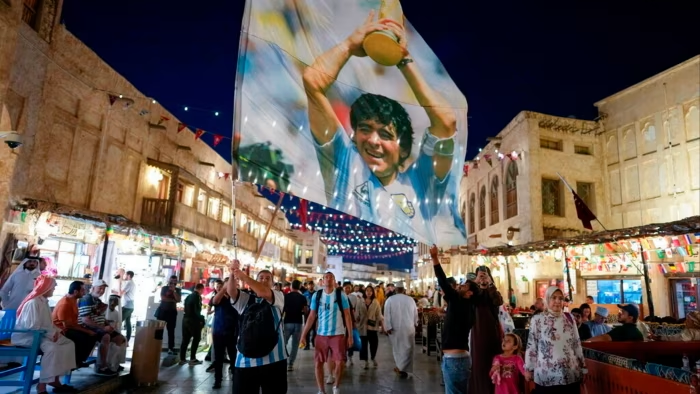
The most buzzing place in Qatar during the World Cup 2022 was the Doha metro. The system operated on the assumption that passengers had never used a metro before. All day, every time a train pulled up at the platform, Filipina “event team” members would point at it and explain, “Sir, you can get into the train.”
Ahead of the World Cup, the story had been the clash of civilisations: westerners were criticising Qatar, while Arabs called us hypocritical racists. And in an era of nativist politics, the World Cup was supposedly a festival of nationalism.
That backdrop made riding the trains confusing. Since Qatar had almost no public spaces, the metro was where the civilisations met, and they got along just fine. In a typical carriage, you might see male Saudis packed together with Iranian men and women and shaven-headed Englishmen, while everyone filmed everyone else, and bantered in basic English. Women in burkas mingled with women in shorts. Brazilians even mingled with Argentines. People weren’t just tolerant of religious difference; they were tolerant of breathing in somebody’s body odour and listening to their terrible music on speaker at 1am, in a crammed carriage after their team had lost.
It was the spirit of the World Cup. I hope to feel it again next summer, ideally in a city I haven’t been to before and will never see again.
Simon Kuper is the author of “World Cup Fever: A Footballing Journey in Nine Tournaments” (Profile Books)
Find out about our latest stories first — follow FT Weekend on Instagram, Bluesky and X, and sign up to receive the FT Weekend newsletter every Saturday morning