The day our bus caught fire, I was trying to catch some sleep. I was curled up a few rows back from the on-board toilet when one of the passengers stuck his head up from the stairwell and said, “Um, I think there’s smoke?”
Not words you want to hear when you’re leading a tour of young travellers through Western Europe. So I walked to the toilet, pulled the door open and there, indeed, was smoke. And fire.

Our bus (sorry, “coach”), was at this point hurtling down a B-road somewhere in the Tyrol region of Austria. It was a truly beautiful spot for our driver to scream to a halt so we could evacuate all the paying guests and set about putting out the fire.
Then we all waited a few hours on a grassy verge in the shadow of alpine cliffs until a replacement coach arrived and we could get on our way.
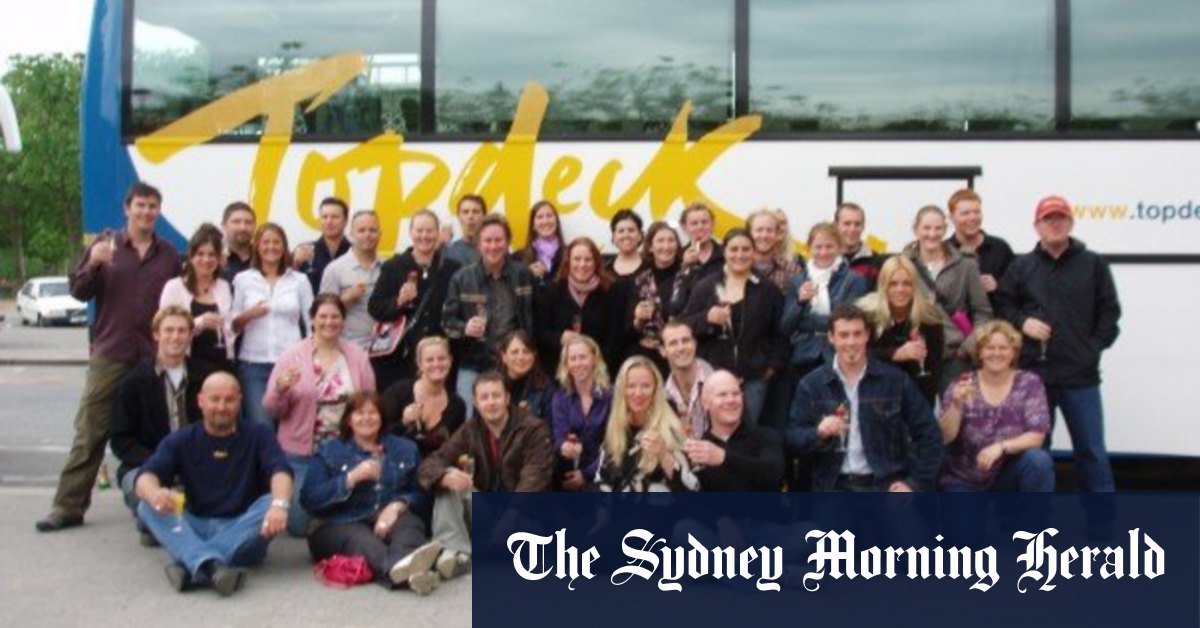
I suppose it’s wrong to lament the fact that modern-day passengers on Topdeck will never have that experience. The tour company announced recently that, by April, it will be doing away with its large, 50-passenger coaches, and focusing instead on small-group journeys – maximum 18 passengers, with a maximum age limit now of 32 (down from 39) – that utilise trains, ferries and smaller vehicles.

For people like me who used to work on those giant coaches, who used to clean them and sleep in them and sometimes even rescue them from fire, this is a sad day. It’s also yet another indication that the tours of old we used to love providing just don’t exist for young travellers any more.
Will this make much of a difference? If you ever went on a Contiki or Topdeck tour, particularly one of the lower-priced campsite tours back in the day, you would understand the key role the coach played in those experiences.
It was basically another character on the tour, a meeting place, a venue for city tours, a place to hear the “day song” every morning, a spot to listen to the tour leader bang on while you tried to sleep, a giant phallus for the driver to lovingly polish.
It was a place the three-person crew (driver, tour leader, cook) would sometimes sleep, lilos thrown onto the floor of the luggage bins, the doors propped open by a broomstick. Various other shenanigans were hosted on those buses overnight too, none of which were sanctioned even at the time, and would be far less acceptable now.

But anyway, this column is pure nostalgia, because it’s not like Topdeck is doing the wrong thing. The world changes, generations change, travel changes, and this is clearly what young people want from their big European adventure these days.
And those tours of the ’90s and noughties were never perfect. It seems laughable now when you realise that all those trips used to have to start in London because sending passengers to mainland Europe on their own was considered far too scary. They all needed the safety of an English-speaking meet-up before travelling as a pack into the great unknown (France).
And who really wants packs of 40 or more drunken Australian and Kiwi school-leavers roaming the otherwise charming, medieval cities of Europe making a nuisance of themselves. (It’s fun when you’re the nuisance, less so when you’re anyone else.)
The great camping tours of old have been effectively dead for years now anyway. I maintain that the best experiences always came from the cheapest tours: the bonding, the camaraderie, the feeling of freedom was always strongest when people were sleeping in tents and having their dinners sitting in a circle on fold-out chairs.
But young travellers no longer like doing that, so they’re not offered.
Everything has changed. On-board cooks (my old job) were phased out years ago. Stricter EU regulations meant many Aussie and Kiwi bus drivers (sorry, “coach captains”) had to go home and find girlfriends some other way. Tour leaders survive, but given every traveller now already has every piece of information they could ever want in the palm of their hand, the job has markedly altered.
Topdeck’s key competitor, Contiki, meanwhile, is keeping things steady: those big, branded coaches will still be whipping around the Arc de Triomphe next year. Though, the company has already been diversifying its offering, and 25 per cent of Contiki’s Europe tours are now classed as “small-group” trips, many of which utilise local public transport such as trains.
While Topdeck is dropping its age limit down to 32, Contiki remains aimed at those aged 18-35, and the company has even introduced a range of itineraries for those aged 35-45, called “reunion trips” (though you don’t have to have been a previous Contiki customer to participate).
Now that, for a gnarly old tour cook, warms the cockles of the heart. Old tour passengers are still out there having fun. Let’s just hope that if their coach catches fire, someone will be experienced enough to know what to do about it.
Sign up for the Traveller newsletter
The latest travel news, tips and inspiration delivered to your inbox. Sign up now.
 Ben Groundwater is a Sydney-based travel writer, columnist, broadcaster, author and occasional tour guide with more than 25 years’ experience in media, and a lifetime of experience traversing the globe. He specialises in food and wine – writing about it, as well as consuming it – and at any given moment in time Ben is probably thinking about either ramen in Tokyo, pintxos in San Sebastian, or carbonara in Rome. Follow him on Instagram @bengroundwaterConnect via email.